Oyamori Learning
Learn systematic trading.
Guides, explainers, and tutorials on systematic trading, market edges, AI sentiment signals, and quantitative strategy. Written by the team behind Oyamori.
Browse by Topic
Explore articles by category.
Trading Edges
Every edge in the Oyamori catalog — what it is, why it works, and how to deploy it.
▶Getting Started
From idea to live algo: CLI tutorials, workflow guides, and platform setup.
⬡Risk Management
Position sizing, drawdown limits, backtesting reality, and portfolio-level protection.
⬟Sentiment & AI
How Newsvibe sentiment data integrates with systematic strategies to sharpen signals.
Start Here
Risk Management
Why Stocks Fall When Earnings Are Good: The Froth Model
Why stocks fall when earnings are good — because most of the price was expectation, not value. How to separate base value from froth before it deflates.
13 min read →Edges
SMC ICT Checklist: 20 Steps to Validate a Setup Before You Enter
An SMC ICT checklist that turns Price Action, liquidity, and market structure into one repeatable 20-step plan you run before every single entry.
17 min read →Edges
Smart Money Algorithm: A Developer's View of Order Execution
A smart money algorithm isn't one bot that sees everything — it's a parent order split into thousands of child orders. The developer's view of execution.
9 min read →Edges
How to Trade Support and Resistance Without Getting Stopped Out
How to trade support and resistance the right way: the 3 mistakes that get you stopped out, the fixes, and two checklists to grade a level before you click.
13 min read →Edges
The Session Clock: When Every Market Actually Trades
The Session Clock hub: a live 24-hour timeline of stocks, forex, crypto, gold and futures — see when each market wakes, and the window where they all peak.
6 min read →Edges
Time of Day Trading: The Intraday Session Regime Clock
Time of day trading: why the market trends at 10am, chops at lunch, and wakes at the close — the intraday session-regime clock (ET) that filters every signal.
12 min read →Risk Management
Trading Survival Mindset: Why You Survive First, Then Get Rich
Trading survival mindset: markets pay the disciplined, not the right. Money management is the survival equation; beat yourself before the chart.
11 min read →Edges
Why Price Pulls Back: The Hidden Mechanics Behind Every Trend
Why price pulls back: the order-flow and psychology behind impulse, pullback, and continuation — and why waiting for the retrace beats chasing green candles.
10 min read →Edges
Multi-Timeframe Entry: Premium, Discount & the Right Moment to Buy
Multi-timeframe entry timing: why price is discount on the 1H yet premium on the 10m — and exactly where in the dealing-range stack you actually enter.
11 min read →Edges
When to Enter a Long: The Confirmation Stack That Beats Guessing the Bottom
When to enter a long precisely: don't buy at support. Learn the bullish SMC entry pipeline — discount sweep, displacement, structure shift, retest.
8 min read →Edges
When to Enter a Trade: The Confirmation Stack That Beats Guessing the Top
When to enter a trade precisely: don't short at resistance. Learn the SMC entry pipeline — sweep, displacement, structure shift, retest — on a real chart.
9 min read →Getting Started
Fear in Trading: Why You Freeze, Cut Winners, and Hold Losers
Fear in trading rewires your brain to freeze, cut winners early, and hold losers. Learn the biology, loss aversion, and 5 tools to take back control.
7 min read →Edges
SMC/ICT & Candlestick Patterns + Price Action: The Atoms of Liquidity
SMC vs candlestick patterns: the hammer is a liquidity sweep, the double top is equal-highs liquidity, an order block is a candle. 30 patterns mapped to SMC.
6 min read →Edges
SMC/ICT vs the Classics: The Ultimate Side-by-Side Comparison
The ultimate SMC/ICT vs Wyckoff, Dow, Elliott, candlesticks, supply-demand and Fibonacci comparison — every framework side by side in one master table.
9 min read →Edges
SMC/ICT & Dow Theory: Where Market Structure Came From
SMC vs Dow Theory: higher highs and lows are market structure, BOS/CHoCH is Dow's reversal rule. See how SMC formalized the 120-year-old foundation of trends.
5 min read →Edges
SMC/ICT & Elliott Wave: What Translates and What Doesn't
SMC vs Elliott Wave: impulse and correction map to displacement and sweeps, wave 2 grabs liquidity — but the rigid 5-3 count and Fib ratios don't translate.
6 min read →Edges
SMC/ICT & Fibonacci: How ICT Repurposed the Golden Zone
SMC vs Fibonacci: ICT repurposed the 0.62–0.79 golden pocket as the OTE. See the full map and why fib only works anchored to an order block.
5 min read →Edges
SMC/ICT & Classic Indicators: Structure vs Derived Signals
SMC vs indicators: RSI and MACD are derived momentum, SMC reads liquidity structure. Learn which indicators bridge to SMC (VWAP, volume) and which conflict.
5 min read →Edges
SMC/ICT & Market Profile: Accepted Value Is Liquidity
SMC vs Market Profile / Auction Theory: the POC is a liquidity magnet, the value area is the dealing range, and excess is a sweep — the full map.
6 min read →Edges
SMC/ICT & Supply & Demand: The Same Zone, More Context
SMC vs supply and demand: a demand zone IS a bullish order block. See the term-by-term map, and the liquidity context SMC adds to filter which zones to trade.
5 min read →Edges
SMC/ICT & Wyckoff: The Same Playbook, 90 Years Apart
SMC vs Wyckoff, fully mapped: the Spring is a liquidity sweep, accumulation is liquidity building. Every Wyckoff event in ICT terms, and how to combine them.
6 min read →Sentiment & AI
How to Trade FOMC Day: From Zero to a Clear Game Plan
How to trade FOMC day explained from scratch — what the Fed decision is, the 2:00 and 2:30 timeline, why surprise moves price, and a step-by-step game plan.
9 min read →Risk Management
Law of Large Numbers in Trading: Why You Blow Up Before Your Edge Pays
The law of large numbers in trading explains why an edge only shows over many trades. Learn risk of ruin, bankroll management, and why survival wins.
8 min read →Edges
Scalping Indicators: A Quant's Guide to Speed, Regime & No-Trade Filters
Scalping indicators that measure price speed and filter no-edge chop — a quant catalog of 30+ tools with formulas and TradingView Pine v6 notes.
18 min read →Edges
Inducement in SMC: The Bait Smart Money Sets Before the Move
Inducement in SMC is the bait, not the liquidity. Learn how smart money traps retail before the real move, how to score it, and its lifecycle across timeframes.
8 min read →Risk Management
Trading Metrics: 14 Numbers That Prove Your System Works
Trading metrics turn a gut feeling into proof. Learn 14 numbers — win rate, profit factor, expectancy, drawdown, Sharpe — with formulas and fixes.
8 min read →Edges
Liquidity Candle: Why the Market Fakes the Open Before It Reverses
A liquidity candle is the engineered opening flush that traps retail before reversing. Learn why it happens, the 25% ATR test, and the outside-range entry.
7 min read →Edges
Opening Range Reversal: The Pattern Scalp That Fades the Open
The opening range reversal scalp fades the aggressive first 15-minute candle. Learn to spot manipulation candles with ATR and enter on John Wick reversals.
7 min read →Edges
Liquidity Sweep Trading: Trade the Stop Hunt, Don't Be It
Liquidity sweep trading turns stop hunts into entries. Learn to spot BSL/SSL pools, tell a sweep from a breakout, and trade the reclaim with real use cases.
7 min read →Edges
Order Flow Trading: Read the DOM & Footprint Like a Pro
Order flow trading reads the raw buyer-seller battle behind every candle. Learn the DOM, footprint charts, delta, absorption, and exhaustion with use cases.
7 min read →Edges
Are Trading Indicators Fake? 11 Tools Scored by Evidence
Trading indicators ranked by how well each reflects real market behavior — order flow, VWAP, liquidity, RSI, MACD scored 0–10 with how to use each.
8 min read →Edges
Volume Profile Trading: POC, Value Area & How to Use Them
Volume profile trading maps where the market accepted value. Learn the POC, value area, HVN and LVN nodes, profile shapes, and the setups they signal.
7 min read →Edges
Gap and Go Strategy: The Momentum Scalp That Trades the Open
The gap and go strategy trades morning gappers with a 3-step system: build the watchlist, grade the gap, enter the opening range. Rules, R:R, and examples.
9 min read →Edges
How Market Makers Trade: The Options Machine That Moves Price
How market makers trade, revealed: they hedge deltas, harvest premium, and pin price to open-interest walls. Learn to read the same signals retail can't see.
13 min read →Edges
SMC Multi-Timeframe Analysis: The Complete Top-Down Blueprint
SMC multi-timeframe analysis maps HTF bias to LTF entries — master top-down with POI ranking, inducement, liquidity, and a full worked trade.
13 min read →Edges
Trade Entry Strategies: 15 Entry Methods and When to Use Each
Trade entry strategies — 15 ways to time an entry (breakout, pullback, order block, FVG, liquidity sweep) grouped by market condition with a decision guide.
14 min read →Oyamori
Oyamori Cognitive Framework: DNA, Pulse & Score Explained
The Oyamori Cognitive Framework organizes market intelligence into three layers — DNA, Pulse and Score — answering what it is, what's happening, what to do.
7 min read →Onboarding
The Developer's Guide to Quantitative Trading
If you can write a function, you can understand quant trading. Finance concepts translated into software engineering terms — without the jargon or the hype.
7 min read →Getting Started
How Oyamori Works — A Technical Overview for Skeptical Developers
What does Oyamori do, how does it connect to your brokerage, and what happens when a trade goes wrong? Answers for developers who will not accept a black box.
7 min read →Fundamentals
What Is a Trading Edge? (And Why Most Traders Don't Have One)
An edge is a repeatable market condition where the odds tilt in your favor. Most investors trade on hope. Here's the difference — and how to find one.
7 min read →All Articles
Showing 159 of 159 articles
Getting Started
Clean Traffic in Price Action: How to Score the Path to Target
Clean traffic in price action measures how much structure sits between entry and target. Score the path, separate it from FVGs, and manage runners honestly.
Edges
Pressure Break: Do Multiple Tests of Support Make It Break?
Multiple tests of support with fading bounces look like a breakdown setup. We coded the A+ Pressure Break and tested 19,276 M1 breaks. Here is the data.

Edges
Breakout Options Execution on M1: Entry, Structural Stop, Runner
Breakout options execution on M1 for SPY, QQQ, IWM, TSLA, AAPL: why breaks run or come back, what sideways changes, momentum entry, structural stop and runner.

Sentiment & AI
Fed Rate Hike Impact on Stocks: What Moves, Why, and by How Much
Fed rate hike impact on stocks, ticker by ticker: how 25bp flows through yields, USD and credit into SPY, QQQ, IWM, JPM, COIN and MSTR, with a scenario map.
Edges
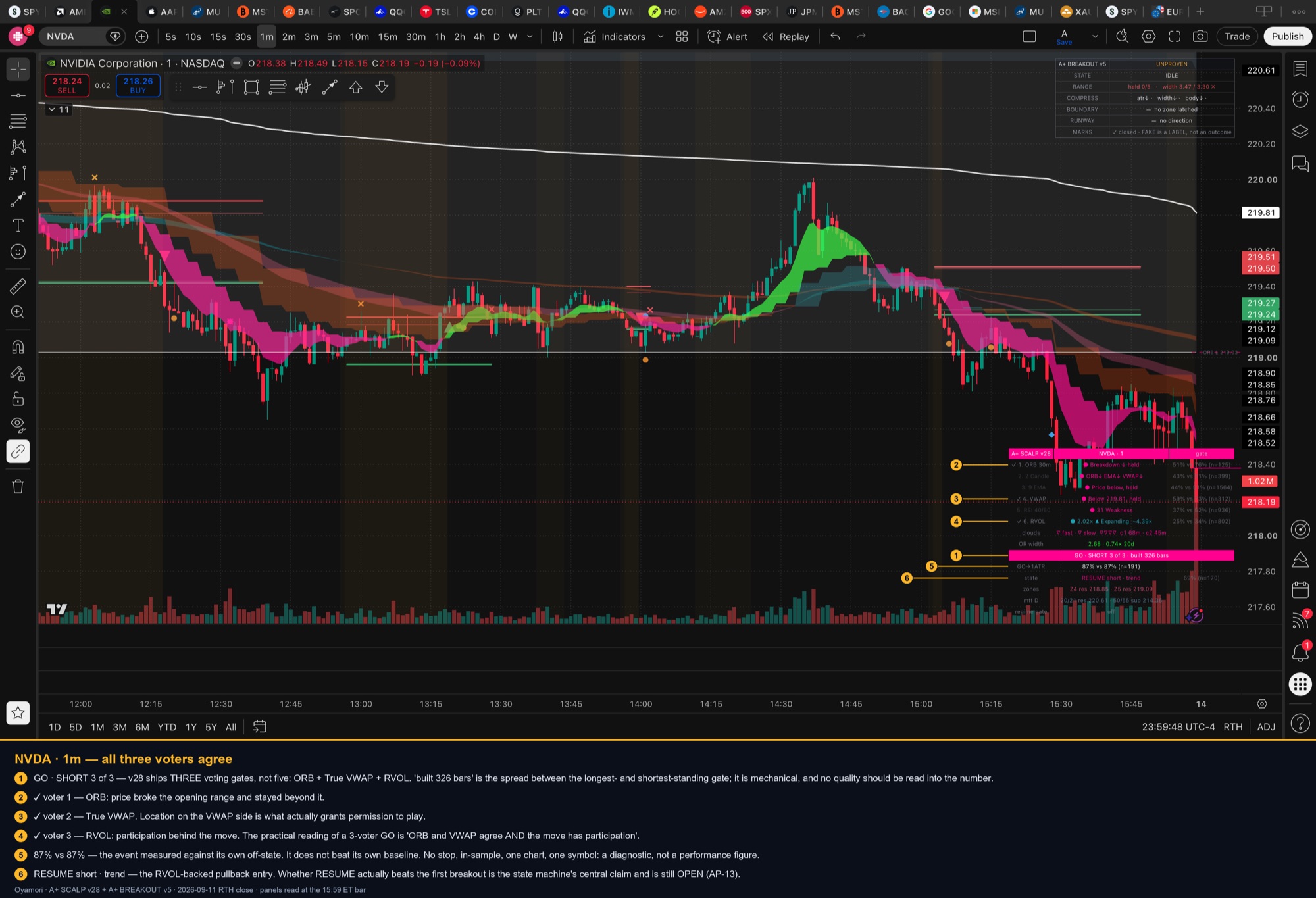
Breakout Scalp Entry: Price Action Leads, the Indicator Gates
A breakout scalp entry method for M1 where price action decides the trade and the indicator only decides the timing, with the measured limits of both.
Edges
Fake Breakouts: Why You Don't Need to Tell Them Apart
Fake breakouts are treated as a prediction problem. 489 real breakouts show the failed ones still pay an impulse — a third the size, for four minutes.
Risk Management
0DTE Strangle: 374 Sessions of Real Traded Prices
A 0DTE strangle looks unbeatable on the day it works. Real traded prints across 374 sessions show the strikes you can afford are not the ones price reaches.
Edges
Intraday Relative Volume: The Baseline Almost Everyone Gets Wrong
Intraday relative volume is measured against the last 20 bars — a clock in disguise. Here is the correct baseline, and a 500-session test of the entry.
Risk Management
Why Stocks Fall When Earnings Are Good: The Froth Model
Why stocks fall when earnings are good — because most of the price was expectation, not value. How to separate base value from froth before it deflates.
Edges
0DTE Strike Selection: The Base-Rate Test Your Contract Must Pass
0DTE strike selection starts with one number: the move your contract needs to break even. 260 sessions per symbol show how often each one actually pays it.
Edges
Chart Reversal Patterns: Every Way Price Turns at a Zone
Chart reversal patterns come in two behaviours: instant rejection or consolidation first. 23 formations, win rates by timeframe, and what confirms a turn.
Risk Management
Your Option Spread Costs 8.6x the Stock Tick — Every Timeframe
Options bid-ask spread costs 8.6x the underlying tick on every timeframe. See the real cost in R, why filter-hunting fails, and the one lever you control.
Edges
Scalp Entry Checklist: Eight Layers Before You Click
A scalp entry checklist in eight layers — regime, location, structure, clouds, liquidity, trigger. Worked from a real TSLA entry that was one layer short.
Risk Management
Trade Loss Attribution: Was It the Read, the Instrument, or the Exit?
Trade loss attribution in three questions: read, instrument, or exit? A worked 0DTE loss where the prediction was right and the contract still paid nothing.
Edges
Why Price Reverses at Key Levels: The Four Borders of a Day
Why price reverses at key levels comes down to four borders — the clock, a higher timeframe, the session mean, and memory. Worked on one real SPX session.
Edges
0DTE Lotto Trades: 0 of 80 Days Paid the $0.04 Strike
0DTE lotto trades tested on 1,716 sessions: the market-open Judas reversal is real and measurable, but the $0.04 far strike paid on 0 of 80 TSLA expiries.

Risk Management
Margin Call Cascade: How Leverage Broke a $45B Fund and the KOSPI
A margin call cascade wiped 350,000 Korean accounts and a $45B AI fund in the same week of July 2026. The leverage math, the timeline, and the exit rules.
Edges
Long Lower Wick in an Uptrend: Reading a Sell-Side Liquidity Sweep
A long lower wick in an uptrend is usually a sell-side liquidity sweep, not a reversal. Read the reclaim, hold the fake dip, don't sell Calls at the low.
Edges
SMC ICT Checklist: 20 Steps to Validate a Setup Before You Enter
An SMC ICT checklist that turns Price Action, liquidity, and market structure into one repeatable 20-step plan you run before every single entry.
Edges
Smart Money Algorithm: A Developer's View of Order Execution
A smart money algorithm isn't one bot that sees everything — it's a parent order split into thousands of child orders. The developer's view of execution.
Edges
Crypto Trading Hours: The Clock Inside a 24/7 Market
Crypto trading hours explained: why a 24/7 market still has peak US hours, weekend low-liquidity traps, 8-hour funding windows, and the CME Bitcoin gap.
Edges
Forex Trading Sessions: The London–New York Clock
Forex trading sessions explained: Sydney, Tokyo, London and New York, the killer overlap, ICT killzones, and which pair to trade in each session (times ET).
Edges
Gold Trading Hours: The XAU/USD Session Clock
Gold trading hours explained: the Asian range, the London open and fix, the London–NY overlap where XAU/USD moves most, and the macro events that drive it.
Edges
How to Trade Support and Resistance Without Getting Stopped Out
How to trade support and resistance the right way: the 3 mistakes that get you stopped out, the fixes, and two checklists to grade a level before you click.
Edges
Index Futures Sessions: Trading the 23-Hour Globex Clock
Index futures sessions explained: the Globex overnight, the ES/NQ cash open, the overnight range as a map, and why RTH and ETH are two different markets.
Edges
Power Hour Trading: Reading the Closing-Bell Sell-Off
Power hour trading: why stocks fade in the last 30 minutes, the market-on-close imbalance that drives it, and a validation gate to filter the days that don't.
Edges
The Session Clock: When Every Market Actually Trades
The Session Clock hub: a live 24-hour timeline of stocks, forex, crypto, gold and futures — see when each market wakes, and the window where they all peak.
Edges
Time of Day Trading: The Intraday Session Regime Clock
Time of day trading: why the market trends at 10am, chops at lunch, and wakes at the close — the intraday session-regime clock (ET) that filters every signal.
Risk Management
Trading Survival Mindset: Why You Survive First, Then Get Rich
Trading survival mindset: markets pay the disciplined, not the right. Money management is the survival equation; beat yourself before the chart.
Edges
Why Price Pulls Back: The Hidden Mechanics Behind Every Trend
Why price pulls back: the order-flow and psychology behind impulse, pullback, and continuation — and why waiting for the retrace beats chasing green candles.
Edges
Multi-Timeframe Entry: Premium, Discount & the Right Moment to Buy
Multi-timeframe entry timing: why price is discount on the 1H yet premium on the 10m — and exactly where in the dealing-range stack you actually enter.
Edges
When to Enter a Long: The Confirmation Stack That Beats Guessing the Bottom
When to enter a long precisely: don't buy at support. Learn the bullish SMC entry pipeline — discount sweep, displacement, structure shift, retest.
Edges
When to Enter a Trade: The Confirmation Stack That Beats Guessing the Top
When to enter a trade precisely: don't short at resistance. Learn the SMC entry pipeline — sweep, displacement, structure shift, retest — on a real chart.
Getting Started
Fear in Trading: Why You Freeze, Cut Winners, and Hold Losers
Fear in trading rewires your brain to freeze, cut winners early, and hold losers. Learn the biology, loss aversion, and 5 tools to take back control.
Edges
SMC/ICT & Candlestick Patterns + Price Action: The Atoms of Liquidity
SMC vs candlestick patterns: the hammer is a liquidity sweep, the double top is equal-highs liquidity, an order block is a candle. 30 patterns mapped to SMC.
Edges
SMC/ICT vs the Classics: The Ultimate Side-by-Side Comparison
The ultimate SMC/ICT vs Wyckoff, Dow, Elliott, candlesticks, supply-demand and Fibonacci comparison — every framework side by side in one master table.
Edges
SMC/ICT & Dow Theory: Where Market Structure Came From
SMC vs Dow Theory: higher highs and lows are market structure, BOS/CHoCH is Dow's reversal rule. See how SMC formalized the 120-year-old foundation of trends.
Edges
SMC/ICT & Elliott Wave: What Translates and What Doesn't
SMC vs Elliott Wave: impulse and correction map to displacement and sweeps, wave 2 grabs liquidity — but the rigid 5-3 count and Fib ratios don't translate.
Edges
SMC/ICT & Fibonacci: How ICT Repurposed the Golden Zone
SMC vs Fibonacci: ICT repurposed the 0.62–0.79 golden pocket as the OTE. See the full map and why fib only works anchored to an order block.
Edges
SMC/ICT & Classic Indicators: Structure vs Derived Signals
SMC vs indicators: RSI and MACD are derived momentum, SMC reads liquidity structure. Learn which indicators bridge to SMC (VWAP, volume) and which conflict.
Edges
SMC/ICT & Market Profile: Accepted Value Is Liquidity
SMC vs Market Profile / Auction Theory: the POC is a liquidity magnet, the value area is the dealing range, and excess is a sweep — the full map.
Edges
SMC/ICT & Supply & Demand: The Same Zone, More Context
SMC vs supply and demand: a demand zone IS a bullish order block. See the term-by-term map, and the liquidity context SMC adds to filter which zones to trade.
Edges
SMC/ICT & Wyckoff: The Same Playbook, 90 Years Apart
SMC vs Wyckoff, fully mapped: the Spring is a liquidity sweep, accumulation is liquidity building. Every Wyckoff event in ICT terms, and how to combine them.
Sentiment & AI
How to Trade FOMC Day: From Zero to a Clear Game Plan
How to trade FOMC day explained from scratch — what the Fed decision is, the 2:00 and 2:30 timeline, why surprise moves price, and a step-by-step game plan.
Risk Management
Law of Large Numbers in Trading: Why You Blow Up Before Your Edge Pays
The law of large numbers in trading explains why an edge only shows over many trades. Learn risk of ruin, bankroll management, and why survival wins.
Edges
Scalping Indicators: A Quant's Guide to Speed, Regime & No-Trade Filters
Scalping indicators that measure price speed and filter no-edge chop — a quant catalog of 30+ tools with formulas and TradingView Pine v6 notes.
Edges
Inducement in SMC: The Bait Smart Money Sets Before the Move
Inducement in SMC is the bait, not the liquidity. Learn how smart money traps retail before the real move, how to score it, and its lifecycle across timeframes.
Risk Management
Trading Metrics: 14 Numbers That Prove Your System Works
Trading metrics turn a gut feeling into proof. Learn 14 numbers — win rate, profit factor, expectancy, drawdown, Sharpe — with formulas and fixes.
Edges
Liquidity Candle: Why the Market Fakes the Open Before It Reverses
A liquidity candle is the engineered opening flush that traps retail before reversing. Learn why it happens, the 25% ATR test, and the outside-range entry.
Edges
Opening Range Reversal: The Pattern Scalp That Fades the Open
The opening range reversal scalp fades the aggressive first 15-minute candle. Learn to spot manipulation candles with ATR and enter on John Wick reversals.
Edges
Liquidity Sweep Trading: Trade the Stop Hunt, Don't Be It
Liquidity sweep trading turns stop hunts into entries. Learn to spot BSL/SSL pools, tell a sweep from a breakout, and trade the reclaim with real use cases.
Edges
Order Flow Trading: Read the DOM & Footprint Like a Pro
Order flow trading reads the raw buyer-seller battle behind every candle. Learn the DOM, footprint charts, delta, absorption, and exhaustion with use cases.
Edges
Are Trading Indicators Fake? 11 Tools Scored by Evidence
Trading indicators ranked by how well each reflects real market behavior — order flow, VWAP, liquidity, RSI, MACD scored 0–10 with how to use each.
Edges
Volume Profile Trading: POC, Value Area & How to Use Them
Volume profile trading maps where the market accepted value. Learn the POC, value area, HVN and LVN nodes, profile shapes, and the setups they signal.
Edges
Gap and Go Strategy: The Momentum Scalp That Trades the Open
The gap and go strategy trades morning gappers with a 3-step system: build the watchlist, grade the gap, enter the opening range. Rules, R:R, and examples.
Edges
How Market Makers Trade: The Options Machine That Moves Price
How market makers trade, revealed: they hedge deltas, harvest premium, and pin price to open-interest walls. Learn to read the same signals retail can't see.
Edges
SMC Multi-Timeframe Analysis: The Complete Top-Down Blueprint
SMC multi-timeframe analysis maps HTF bias to LTF entries — master top-down with POI ranking, inducement, liquidity, and a full worked trade.
Risk Management
Trading Liquidity: The One You Hunt and the One That Hunts You
Trading liquidity means two different things — resting stops you hunt, and market depth that costs you. Real option chain data on which one takes your money.
Edges
Judas Swing: How to Tell a Fake-Out From a Real Breakdown
Judas swing — the opening sweep that fakes a breakdown then reverses. The reclaim test that separates it from a real markdown, checked against real tape.
Getting Started
Entry Confirmation Checklist: Why Waiting Beats the Perfect Price
Entry confirmation checklist: seven gates that stop you buying assumed bottoms or chasing extended price, with the expectancy math that proves waiting pays.
Edges
Support and Resistance: 30 Trading Strategies That Work
Support and resistance trading strategies explained — 30 ways to draw, confirm, and trade S/R levels in gold, forex, and stocks with exact entry rules.
Risk Management
FVG Fill Trades: Why 1DTE Options Punish Counter-Trend Entries
FVG fill trades fail when you fight a strong trend with 1DTE options. Learn why theta punishes counter-trend puts and how to match option DTE to your thesis.
Getting Started
Smart Money in Trading: Who the Big Money Really Is
Smart money in trading is the institutions — banks, funds, whales — whose order flow leaves the FVGs and order blocks that SMC and ICT teach you to track.
Edges
SMC Trading Framework: Trend, Zone & Confirmation Entries
The SMC trading framework stacks trend, a high-probability zone, and a confirmation trigger into one repeatable entry — stop guessing tops, trade structure.
Getting Started
ICT vs SMC Terminology: The Complete Cross-Reference Lexicon
ICT and SMC use different words for the same idea — this cross-reference lexicon maps every term to its SMC, ICT, and traditional-TA equivalent.
Edges
Opening Range Breakout Mistakes: Breach the Range, Don't Chase It
The opening range breakout fails when traders chase the break instead of the retest — heres the breach-and-retreat fix and the trend filter that changes it.

Getting Started
Smart Money Concepts Glossary: The Complete ICT Terms Reference
Smart Money Concepts and ICT trading use unique terms: order blocks, fair value gaps, killzones, liquidity sweeps — all defined here by category.
Edges
Chart Pattern Win Rates: Real Accuracy Measured Across Timeframes
Oyamori measures chart pattern win rates from real RTH bars. See which patterns perform at 15m vs daily, and why most textbook numbers are wrong.
Edges
Liquidity Grab: How Smart Money Hunts Stops Before the Real Move
Liquidity grab explained — why price sweeps highs and lows to trigger stops before reversing, where buy-side and sell-side pools form, and how to trade the reversal.

Edges
Mean Reversion Trading Strategy: Small Repeatable Wins, Real Math
Mean reversion trading strategy explained — fade overextended price to fair value, and how the law of large numbers turns small wins into a real edge.

Edges
Trade Entry Strategies: 15 Entry Methods and When to Use Each
Trade entry strategies — 15 ways to time an entry (breakout, pullback, order block, FVG, liquidity sweep) grouped by market condition with a decision guide.
Getting Started
Support and Resistance Zones: The Price Skeleton Every Trader Reads
Support and resistance zones explained from first principles — why price reacts to them, the five ways to find them (pivots, ATR clusters, Donchian, volume, EMA clouds), and the mistakes that turn a real level into a trap.
Edges
What TickerDNA Measures — Behavioral Fingerprints Explained
TickerDNA scores every ticker across 5 behavioral strands — overnight gaps, volatility regime, intraday trend, volume rhythm, and event reaction. Here is what each strand measures and how to read the percentiles.
Edges
Nasdaq Day Trading System: The Complete 10-Year Proven Framework
The complete Nasdaq day trading system from a 10-year trader and bestselling author — 5 trader levels, 2 indicators, 3 strategies, risk rules, and pseudo code for every concept.
Edges
Momentum Catalysts: The Complete Options Trader's Playbook
Master momentum catalysts for options trading: 10-category taxonomy, IV Rank gate, fade vs ride framework, catalyst stacking, and live API sources per type.

Edges
Open Interest Explained: How to Read Futures and Options Positioning
Open interest explained — what OI means, how it differs from volume, and how to read price and OI together in futures and options to spot real positioning.
Edges
Oyamori Contract Score™: The Greek Efficiency Method for Options
Oyamori Contract Score™ ranks options contracts by Greek efficiency: normalize Delta, Gamma, Theta, and Vega to 0–100, then weight by GammaTheta Ratio.
Edges
Trend-Filtered DCA vs Standard DCA: The Calmar Ratio Test
Trend-filtered DCA exits to cash when EMA(10) turns bearish, then redeploys in a lump sum — cutting max drawdown from 52% to 19% at the cost of 0.8% CAGR.
Edges
0DTE Scalping Tickers: The 7 Most Liquid Underlyings Ranked for Speed
0DTE scalping tickers ranked by spread, gamma, and best window — SPY, QQQ, SPX, IWM, TSLA, NVDA, AAPL — for the very-short scalper who lives on fills.

Sentiment & AI
Machine-Readable Market Data: From Candlesticks to Market State
Machine-readable market data turns 200 years of candlestick knowledge into executable intelligence — how Oyamori reads market states instead of charts.

Sentiment & AI
The Oyamori Thesis™: From Predicting Markets to Measuring Market Energy
Market energy trading measures whether price will move — not which way. Oyamori reads momentum, volume, and volatility expansion to time options entries.
Getting Started
Market Structure: 13 Levels of Capital Flow From Fed to Your P&L
Map the market structure hierarchy from the Fed to your P&L across 13 levels. See where capital enters, how orders route, and exactly where you sit.
Oyamori
Oyamori Cognitive Framework: DNA, Pulse & Score Explained
The Oyamori Cognitive Framework organizes market intelligence into three layers — DNA, Pulse and Score — answering what it is, what's happening, what to do.
Getting Started
Call, Put, Long, Short: The 2×2 Mental Model for Options
Call, put, long, short explained with one simple 2×2 mental model. Decode any option position in a single breath — right vs obligation, bullish vs bearish.
Edges
Open Interest in Options: How Traders Use OI to Read the Market
Open interest reveals how many active options contracts exist, giving traders a direct read on conviction, positioning, and where institutional money flows.
Edges
Options Flow Trading Strategies: 5 Playbooks That Use Unusual Activity
Options flow signals where institutional money moves — these 5 playbooks show exactly how traders turn unusual activity into high-conviction entries with defined risk.
Getting Started
OptionStrat Guide: Visualize Options Strategies Before You Trade
OptionStrat is the go-to options visualizer for retail traders — risk graphs, break-evens, probability of profit, and scenario testing in one place.
Getting Started
How to Read an Option Chain: Strikes, Greeks & Expirations
How to read an option chain explained: decode strikes, delta, gamma, theta from a real AAPL snapshot, and discover who actually sets strike prices.
Edges
Volume vs Open Interest: Powering an Options Alert Scanner
Volume vs open interest in options: the ratio that flags unusual activity, plus a scoring engine that ranks contracts into three alert tiers automatically.
Developer
Options Chain Data Providers: Free and Real-Time Sources
Options chain data providers for traders: free delayed feeds, real-time APIs, screeners, historical data, charting platforms, and volatility tools compared.
Edges
Options Flow: Reading the Smart Money Signal
Options flow tracks real-time institutional options orders — large premiums, sweeps, and dark pool prints that reveal where Smart Money is placing bets before price moves.
Getting Started
Options Leverage by Moneyness: ITM, ATM, OTM Fully Compared
Options leverage shifts dramatically across moneyness. Deep OTM gives 116x leverage with lottery-like risk; ATM is where day traders find the best balance.
Getting Started
Options Trading Cheat Sheet: 252 Terms by Priority Level
Master 252 options trading terms organized by priority level — from call/put basics to Greeks, implied volatility, and professional strategy jargon.
Edges
Options Price Target Timing: 11 Methods to Estimate When Price Arrives
Options price target timing has 11 quant methods — from Black-Scholes 1σ time to Monte Carlo. This guide maps which engine fits your asset, horizon, and data.
Edges
Trendlines: Reading Market Direction with Diagonal Lines
Trendlines reveal market direction by connecting swing highs or lows with a diagonal line. Learn to draw, read, and trade uptrends, downtrends, channels, and reversals with chart examples.
Edges
Options Chain API: AlphaVantage vs Alpaca for Quant Traders
Options data API comparison: AlphaVantage provides 15 years of history; Alpaca gives live greeks, OI via contract endpoint. Real AAPL and SPY data compared.
Edges
Cross-Exchange Crypto Arbitrage: Real Math, Real Friction, Real Edge
Cross-exchange crypto arbitrage between Binance, Kraken, and Bitkub promises risk-free profit. The real math on fees, slippage, and withdrawal costs tells a different story.
Options Trading Terminology: The Complete Jargon Guide
Master every options trading term — from calls and puts to Greeks, IV crush, and spread strategies — with an interactive reference guide.
Getting Started
Pre-Order Checklist: From Novice to Pro Before You Place a Trade
A tiered pre-order checklist for stock traders — 3 checks for beginners, 5 gates for intermediates, and the full pro system before any scalp entry.
Getting Started
Backtesting a Trading Strategy: What the Results Actually Mean
Learn how backtesting a trading strategy works, what metrics matter, how to spot overfitting, and why out-of-sample validation is non-negotiable.
Edges
Gap and Go Strategy: A Systematic Edge in the Opening 30 Minutes
The gap and go trading strategy turns pre-market momentum into a structured intraday edge. Learn the qualification criteria, entry rules, and backtested stats.
Getting Started
How to Read Stock Charts: The Systematic Trader's Framework
Learn how to read stock charts as a systematic trader — candlestick anatomy, support and resistance, trend structure, volume, and when to use each chart type.
Risk Management
Kelly Criterion: Size Your Positions for Maximum Long-Run Growth
Learn how Kelly Criterion calculates the optimal position size for your trading edge — with formula, Python, live calculator, and fractional Kelly explained.
Reference
Markdown Components Reference
Live reference for every supported markdown component on Oyamori Learning — callouts, syntax highlighting, charts, tables, and standard formatting.
Sentiment & AI
News Sentiment Trading: How to Profit Before the Market Reacts
Learn how news sentiment trading works, how AI scores headlines before prices move, and how to build a signal-to-trade pipeline that acts faster than the crowd.

Edges
Price Action Trading: Structure, Conviction, and When It Lies
Price action reads structure — but structure can be faked. Ten real manipulation scenarios plus the mental model for scalp, day trade, and swing timeframes.
Risk Management
Risk of Ruin: The Hidden Math That Destroys Trading Accounts
Risk of ruin is the probability your account hits zero before reaching your goal. Learn the formula, how position size drives it, and how to protect yourself.
Getting Started
Trading Bot Stale Data: Why It Happens and How to Fix It
Trading bot stale data causes bad fills and edge erosion. Learn why IEX feeds lag, how to detect staleness, and which data feed to upgrade to for your strategy.

Edges
Market Data for Algo Traders: IEX, NBBO, and SIP
What every algorithmic trader must know about US market fragmentation — why IEX-only feeds break scalp bots and how NBBO and SIP data change execution.
Edges
US Stock Trading Lifecycles: Scalper vs. Daily Trader vs. Options Trader
How scalpers, daily traders, and options traders each enter, manage, and exit positions — with win rates, capital requirements, and time-at-screen compared.
Fundamentals
Algorithmic Trading Without a Hedge Fund
Quant infrastructure once required institutional AUM and a fund structure. Here's what changed, what's now accessible to retail investors, and what hasn't gotten easier.

Getting Started
API-First Trading Platform — Why Architecture Determines Strategy Scope
API-first trading platforms are built for automation from day one. That architecture determines which systematic strategies are even possible to run.
Risk Management
Backtesting Is Not Prediction — The Honest Guide to Results
Backtesting a trading strategy does not predict live performance — and a beautiful backtest is often the most dangerous thing in systematic trading.
Onboarding
The Developer's Guide to Quantitative Trading
If you can write a function, you can understand quant trading. Finance concepts translated into software engineering terms — without the jargon or the hype.

Sentiment & AI
Black-Box AI vs. Transparent Sentiment — How to Know What You're Getting
Black-box AI signals are unverifiable. A signal you cannot inspect is one you cannot validate — and a signal you cannot validate is a risk you cannot manage.
Newsvibe
Building a News-Aware Algo — A Python Tutorial with Newsvibe API
End-to-end tutorial: authenticate with Newsvibe API, parse sentiment signals, define entry logic, execute trades via Alpaca, and log results — all in Python.
Getting Started
Why CLI-First Trading Is the Developer's Competitive Advantage
GUI trading hides state, slows iteration, and treats automation as an afterthought. For developers, the CLI is not a preference — it is a structural edge.
Getting Started
CLI vs. GUI for Algo Trading — What You Lose When You Click
Every GUI click cannot be scripted, audited, or repeated exactly. For systematic traders, that is not inconvenience — it is structural friction that compounds.
Tutorial
Connecting Alpaca to Your Trading Strategy — A Developer's Guide
Authentication, market data streaming, order management, and error handling — everything needed to wire a trading strategy to Alpaca's API reliably.
Risk Management
Drawdown Limits — How to Build a Kill Switch Into Your Algorithm
Drawdown limits and kill switches are the one safeguard most algo traders skip — until a strategy crosses its statistical validity boundary and keeps running.
Tutorial
Your First Live Trade via API — A CLI Tutorial with Alpaca and Oyamori
From authenticated API client to confirmed paper trade in under 50 lines of Python. The execution layer, demystified — before adding any strategy logic on top.
Edges
Gap Trading Strategy — How Overnight News Creates Morning Opportunities
Gap trading turns overnight news into a morning signal — stocks that gap on volume exhibit predictable short-term behavior that a prepared algo can exploit.
Newsvibe
How Newsvibe Works — From News Ingestion to Trading Signal
Newsvibe is a sentiment engine you can inspect and validate. Here is how raw news becomes a scored, structured trading signal with tier classification.
Getting Started
How Oyamori Works — A Technical Overview for Skeptical Developers
What does Oyamori do, how does it connect to your brokerage, and what happens when a trade goes wrong? Answers for developers who will not accept a black box.
Tutorial
How to Backtest a Strategy — And What the Numbers Actually Mean
Backtesting is not prediction — it is hypothesis testing. Here is how to run a backtest correctly and, more importantly, how to interpret the results honestly.
Fundamentals
How to Find Your Trading Edge — A Systematic Approach
Finding a trading edge starts with a testable hypothesis, not a backtest. Here's the systematic process for discovering a genuine market inefficiency.
Fundamentals
Hugging Face for Trading Strategies — The Category Oyamori Is Building
Hugging Face built a model hub that democratized AI. Trading strategies need the same model: shared, vetted, executable. Here's what that category looks like.
Risk
Is Algorithmic Trading Legitimate? — How to Spot Real vs. Scam
Algorithmic trading ranges from rigorous systematic strategies to outright fraud. Here's how to tell the difference — and five questions to ask any platform.
Edges
Mean Reversion Explained — How Price Reverts and How to Trade It
Mean reversion is one of the most persistent market phenomena — and one of the most misunderstood. Here's how price reverts, why it works, and how to code it.
Edges
Momentum + Volume — The Edge That Works in Trending Markets
Momentum trading without volume confirmation is noise. Here is why volume makes momentum signals tradeable and how to build the filter in Python.
Getting Started
How to Monetize a Trading Algorithm Without Selling Your Edge
You built a validated trading algorithm. Monetizing it doesn't mean handing over the code or running a fund. Here's the model that lets you earn without either.
Sentiment
News-Driven Gap Trading — Using Overnight Sentiment to Predict Open Gaps
Gap trading meets sentiment scoring — overnight news predicts the morning gap direction if you weight recency, urgency, and volume correctly.
Sentiment & AI
Why News Sentiment Changes Everything in Algo Trading
News sentiment is not a soft signal — it is a structural information advantage. Here is why sentiment-blind algos fail around high-impact news events.
Edges
Options Theta Decay — Harvesting Time Premium Systematically
Theta decay puts time on the seller's side — every day options lose value you never bought. Here's how to harvest it without getting steamrolled.
Edges
Order Flow Imbalance — Reading What the Market Is Actually Doing
Order flow imbalance signals price direction before the chart shows it. Here is how to build a usable proxy from Level 1 data and where the edge decays.
Risk Management
Overfitting vs. Robust Strategies — How to Know the Difference
Overfitting a trading strategy looks perfect on paper and fails immediately in production. Here is how to tell the difference before you go live.
Tutorial
The Oyamori CLI Workflow — From Edge Selection to Live Execution
The complete Oyamori CLI workflow — selecting an edge, configuring risk, connecting your account, and running a live systematic trading strategy.
Edges
The Oyamori Edge Catalog — Market Inefficiencies Explained
A structured inventory of validated market inefficiencies — what each edge exploits, when it performs, and how long positions typically hold.
Edges
Pairs Trading Explained — How Correlation Breaks Create Profit
Pairs trading profits from temporary divergences between correlated assets, market-neutral by design. Here is how cointegration makes it work in practice.
Getting Started
Paper Trading vs. Live Trading — How to Know When You're Ready
Paper trading and live trading feel identical until the moment they don't. A measurable framework for knowing when your strategy is ready for real capital.
Risk Management
Portfolio-Level Risk — Running Multiple Algos Without Blowing Up
Individual strategy limits fail when algos are correlated. Portfolio-level risk is what separates multi-algo accounts that survive from those that don't.
Risk Management
Position Sizing for Algo Traders — From Fixed Dollar to Volatility-Adjusted
Position sizing determines whether a strategy survives long enough to profit. Sizing kills more strategies than bad signals do — here is how to fix it.
Risk Management
Quant Trading vs. Gambling — The Real Difference
Quant trading and gambling share math and uncertainty. The difference is edge: a quantified probability advantage executed consistently, without emotion.
Sentiment & AI
Regime Detection with Sentiment — When to Run Your Algo and When to Pause
Sentiment regime detection is the best signal for when not to trade — aggregate negative sentiment across a broad basket marks risk-off conditions reliably.
Risk Management
The Retail Algo Trader Checklist — Before You Go Live
Most algos fail at deployment, not strategy design. This checklist gives you specific, measurable pass/fail criteria before your strategy touches live capital.
Workflow
Scheduling Trading Algorithms — Cron, Docker, and Serverless
Cron, Docker, and serverless — three approaches to scheduling a trading algorithm. Trade-offs, setup instructions, and when each breaks in production.
Edges
Sector Rotation — Following Institutional Money with Automation
Sector rotation moves predictably through economic cycles as institutional capital reallocates. Here is how to follow that flow systematically with Python.
Sentiment & AI
Sentiment + Momentum — How to Combine News Signals with Technical Edges
Signal fusion cuts false positives: one signal has noise, two calibrated uncorrelated signals have less. Here is the implementation and the math.
AI
Signal Fusion Explained — Why One Signal Is Never Enough
Signal fusion cuts false positives: a single signal has noise, two calibrated uncorrelated signals have less. Here is the math and the architecture behind it.
Edges
Statistical Arbitrage for Retail Traders — Edge, Limits, and Implementation
Statistical arbitrage exploits temporary divergence between correlated assets. Here's the mechanics, the limits, and a Python implementation for retail scale.
Fundamentals
Strategy as a Service: The New Model for Algorithmic Trading
Strategy as a service separates trading logic from capital. Investors access proven algorithms on subscription without code ownership, fund minimums, or custody transfer.
Risk
Strategy Decay — Why Your Edge Stopped Working and What to Do
Every trading edge has a lifespan. Strategy decay ends most algos — here is how to detect regime change, crowding, and structural shifts early.
Tutorial
Setting Up Your Trading Development Environment
A reproducible Python trading environment from scratch — pyenv, core libraries, Alpaca API credentials, and a smoke test that confirms everything works.
Workflow
From Trading Idea to Live Algorithm — The Complete Workflow
Most trading ideas die between hypothesis and deployment. This is the end-to-end workflow — from a market observation to a live, monitored systematic strategy.
Fundamentals
Trading Strategy Marketplace: What It Is and Why It Matters
A trading strategy marketplace lets investors access proven algorithmic strategies without building from scratch. Here's how it works and why it changes retail quant trading.
Risk Management
Transparent Trading Signals — What They Show and Why It Matters
Transparent trading signals show their inputs, timing, and logic — not just the output. Here's what signal transparency looks like and why it matters for risk.
Risk Management
What Makes a Trading Strategy Verifiable — And Why Most Aren't
Most backtests prove a strategy fit historical data — not that it has an edge. Here's the difference between a fitted result and a verifiable trading strategy.
Edges
Volatility Skew Trading — The Options Edge Most Retail Traders Miss
Volatility skew exists because institutions pay a structural premium for downside protection. Here is how to measure it and harvest it systematically.
Fundamentals
What Is a Trading Edge? (And Why Most Traders Don't Have One)
An edge is a repeatable market condition where the odds tilt in your favor. Most investors trade on hope. Here's the difference — and how to find one.
No articles match "".