Getting Started
VWAP With Price Action: Stop Letting VWAP Veto Your Scalp Trades
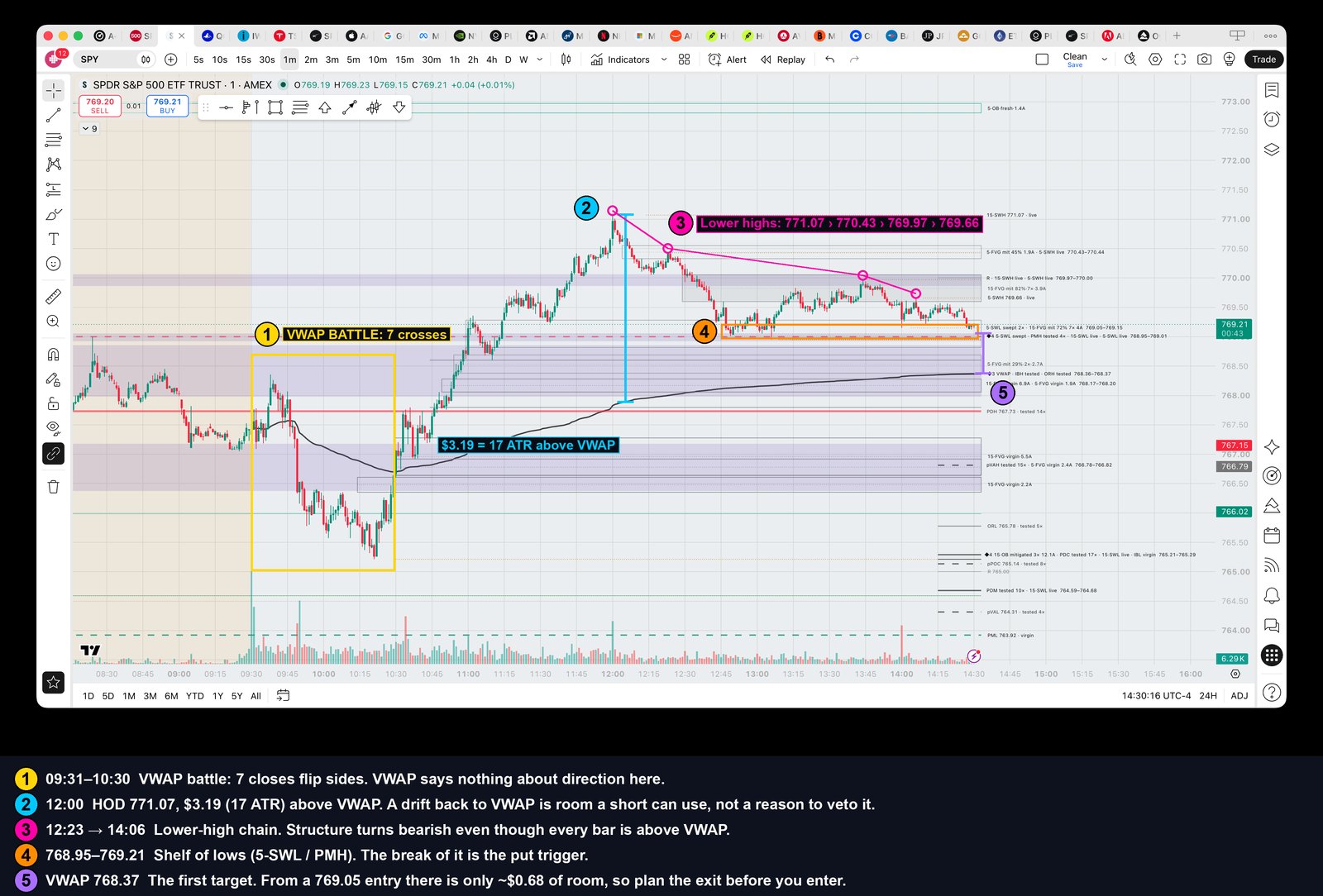
SPY 1-minute, 2026-10-27, annotated by Oyamori
VWAP price action scalping goes wrong when you use the common rule "above VWAP = calls only, below VWAP = puts only." On a one-minute chart that rule throws away good setups and keeps bad ones. A better approach: let price action decide the direction, then use VWAP to grade the trade. VWAP tells you about alignment, location, friction on the path, and where a target sits. This guide gives you the hierarchy, the four VWAP states that replace the binary rule, a way to measure distance from VWAP in ATR and in R, and a live SPY example from 2026-10-27, including the part where the trade never triggered.
Why "Above VWAP = Calls, Below VWAP = Puts" Fails on the 1-Minute Chart
VWAP (volume-weighted average price) is the average price paid for every share traded since the open, weighted by volume. It is a fair-value reference for the session. It is not a direction signal, and the binary rule treats it as one.
We tested the rule rather than argue about it. Oyamori's quant desk took 19,452 bearish one-minute structure breaks across 10 mega-cap and index names over 13 months. The question was whether shorting only below VWAP beats shorting above it.
The gate made no measurable difference. The study had enough power to detect an effect of 0.057R, so this is a real null result, not a small sample. Comparing signals inside the same day makes it worse: the below-VWAP shorts did worse than the above-VWAP shorts.
The reason: VWAP side is mostly a day-level variable. On a down day almost every signal sits below VWAP; on an up day almost every signal sits above it. On about a third of sessions every signal landed on one side. "Below VWAP" was mostly a stand-in for "today is a down day," and a plain close below the open captured the same thing.
Where VWAP Belongs in a Price Action Hierarchy
If VWAP is not the gate, it needs a defined place. Rank the inputs by how directly they describe what buyers and sellers are doing right now:
1. STRUCTURE        HH/HL vs LH/LL · range or trend · shift · acceptance / failure
2. LOCATION         S/R · PDH/PDL · PMH/PML · range edges · FVG / order blocks
3. PRICE BEHAVIOR   pressure · rejection · failed acceptance · compression · displacement
4. PATH QUALITY     clean traffic · obstacles · available R:R
5. VWAP             context modifier: alignment, friction, target. Not a direction gate.
Structure sets the direction. Location says whether this is a sensible place to act. Behavior says whether the level is holding or failing. Path quality says whether the trade has room to pay. VWAP comes last because it summarises the session's average and does not describe the current auction. If you want more depth on the top layer, market structure hierarchy covers how swing structure nests across timeframes.
The 4 VWAP States That Replace the Binary Rule
The question is not "am I above or below VWAP?" It is "what is VWAP doing to this trade?" There are four useful answers.
| 1 · Alignment | 2 · Counter-alignment | 3 · VWAP as Target | 4 · Battle / Chop | |
|---|---|---|---|---|
| Example | Bearish PA below VWAP | Bearish PA above VWAP, VWAP not on path | Bearish PA above VWAP, VWAP below entry | Repeated closes across VWAP |
| Effect | Confirmation bonus | Small confidence haircut | VWAP becomes the first target | VWAP weight near zero |
| Trade allowed | Yes | Yes, no veto | Yes, if room ≥ 1R | Only from range edges |
| Planning | Normal targets | Conservative first target | Bank main size at VWAP | Smaller size, faster exits |
1. Alignment. A bearish structure break below VWAP, or a bullish one above it. The session's average participant is on your side, so trapped traders are more likely to add fuel. Count it as a plus, but it does not upgrade a weak setup into a strong one.
2. Counter-alignment. A bearish setup above VWAP where VWAP is not between you and your target. The trade is allowed. Expect a little less follow-through and keep the first target honest.
3. VWAP as target. This is the most useful state, and the binary rule hides it completely. Price is well above VWAP, structure turns bearish, and VWAP sits below your entry. The move back toward VWAP is the trade. A short here is not "fighting VWAP." It is trading the drift back to fair value, and VWAP is the first logical place to take profit.
4. Battle. Price closes above VWAP, then below, then above again. When that happens four or more times in 30 bars, VWAP carries no direction. The market is balancing around it. Down-weight VWAP to almost nothing, trade the range edges, or wait.
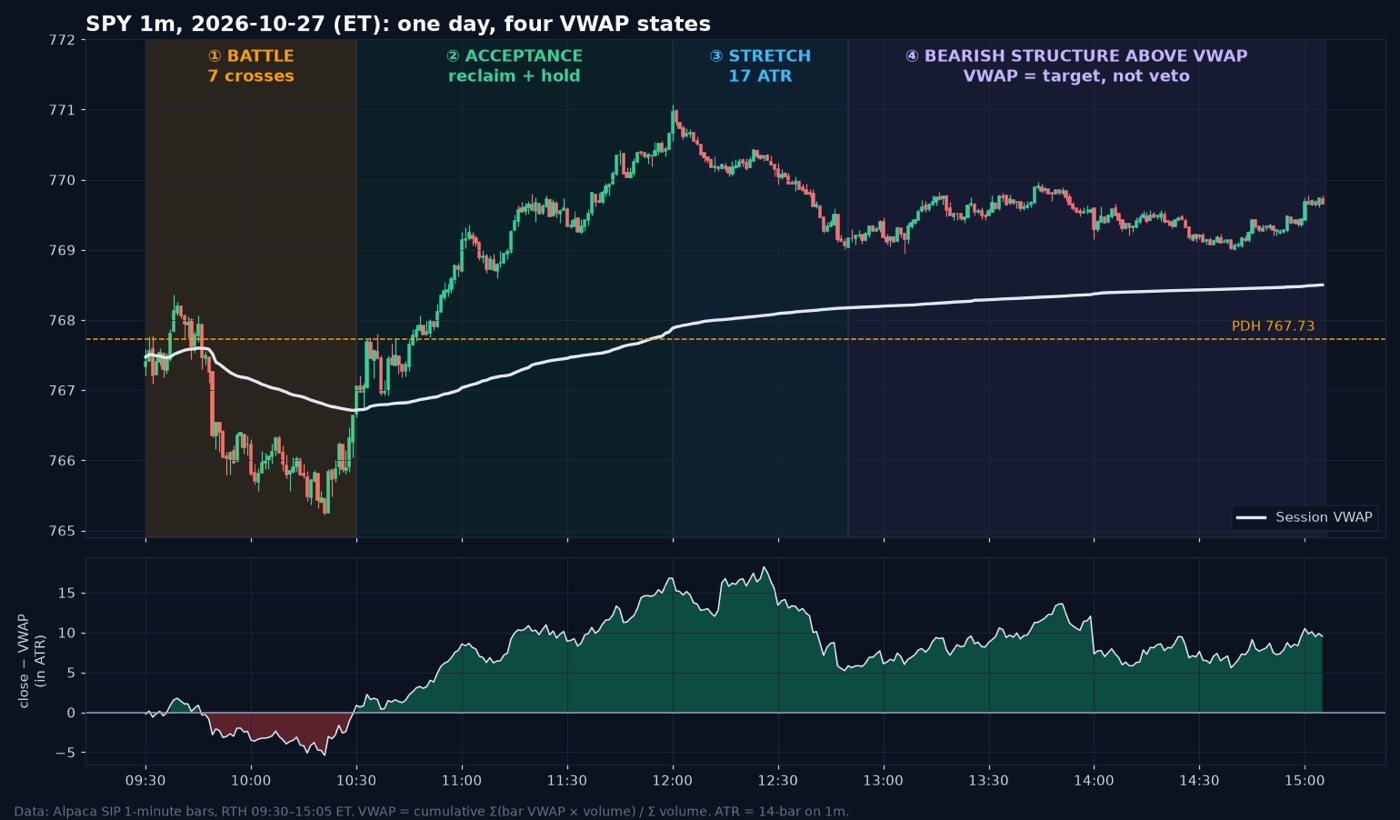
Distance From VWAP Matters More Than the Side
Two shorts can both be "above VWAP" and be completely different trades. One sits 17 ATR above VWAP after an extended rally. The other sits $0.10 above it. The first has a whole leg of room back to the average. The second runs into VWAP almost as soon as it starts.
Measure distance two ways:
- In ATR, to judge stretch: . Use the ATR of the chart you trade (14 bars on M1 is fine).
- In R, to judge room: , counted only when VWAP lies between entry and target.
Read them together:
| Distance in ATR | Room to VWAP in R | What it means for the trade |
|---|---|---|
| Large (8+ ATR) | 1.5R or more | Stretched. A move back to VWAP is part of the opportunity for a fade. |
| Moderate | 1R to 1.5R | Workable. Take the main size off at VWAP. |
| Any | Under 1R | You risk more than you can make before the first likely reaction. Improve the entry or pass. |
| Under 1 ATR | n/a | You are sitting on the line. Expect noise, and do not park a stop just across VWAP. |
This is the same idea as grading the path to target in clean traffic price action. VWAP is one more obstacle on the path, and usually the heaviest one intraday, because so many traders and algorithms watch it.
Let VWAP Earn Its Weight Each Day
Do not give VWAP a fixed weight. Some sessions respect it: price tags VWAP, rejects, and separates, more than once. Other sessions slice through it with no reaction. Let the market show you which kind of day it is.
Raise VWAP's weight when:
- Price has touched VWAP, rejected, and moved away from it at least once today.
- That rejection happened with a clear candle (a wick back from VWAP and a close away from it).
- Your current setup is a rejection of VWAP in your direction, with structure agreeing.
Lower VWAP's weight when:
- Closes have crossed VWAP four or more times in the last 30 bars.
- Price has crossed VWAP without stopping, in either direction, earlier in the session.
- The day has been one-sided for hours, so VWAP is far away and lagging.
On a high-weight day, the VWAP reaction is a real level. Put stops beyond the reaction, not inside it, and expect a stall when you reach it. On a low-weight day, treat VWAP as a line on the chart and nothing more.
The VWAP Logic, Written Out
Here is the whole framework as pseudocode. It is a planning procedure, not a tested signal. The weights are judgement calls you should adjust to your own journal, and no part of it comes with a proven win rate.
direction = derive_from_price_action()        # structure first, never from VWAP

if setup_quality == "A+":
    trade_allowed = True                       # VWAP never vetoes a valid PA setup

if direction == vwap_side():                  # "long" above VWAP, "short" below
    score += 1                                 # alignment: confirmation
else:
    score -= 0.5                               # counter-alignment: haircut, no veto

if vwap_between(entry, target):
    mark_obstacle("VWAP")
    room_r = abs(entry - vwap) / abs(entry - stop)
    if room_r < 1.0:
        downgrade("not enough room before VWAP")
    first_target = vwap                        # VWAP-as-target plan

if closes_across_vwap(last=30) >= 4:
    vwap_weight = "LOW"                        # battle / balance
elif vwap_rejected_today() and structure_confirms():
    vwap_weight = "HIGH"
Try it with your own numbers below. The first preset loads the SPY trade from the next section.
Live Example: Shorting SPY Above VWAP on 2026-10-27
The annotated chart at the top of this page is SPY on the morning of 2026-10-27, captured at 14:30 ET. Every number below comes from SIP one-minute bars.
The session in four acts.
- 09:31–10:30, battle. Closes crossed VWAP seven times in the first hour, while price dropped from 767.34 to a low of 765.21. VWAP said nothing useful about direction.
- 10:30–12:00, acceptance and stretch. Price reclaimed VWAP at 10:30 and never closed below it again. It ran to a high of 771.07 at 12:00, $3.19 above VWAP. With a one-minute ATR of $0.18, that is 17 ATR of stretch.
- 12:00–14:06, bearish structure above VWAP. Lower highs at 770.43 (12:23), 769.97 (13:44) and 769.66 (14:06). A shelf of lows formed at 768.95–769.21. Every bar was above VWAP, and the one-minute structure was bearish.
- 14:30, the decision. Price sat at 769.21 on the shelf. VWAP was 768.43.
Under the binary rule, this chart allows calls only. Under the hierarchy, structure says bearish, location is a shelf that has been tested repeatedly, and VWAP sits below as a target. That is state 3, VWAP as target.
The plan. Sell puts only on a one-minute close below 768.95. Stop above 769.66. Take most of the position off at VWAP, about 1R. Keep a runner toward the prior-day high at 767.73 only if price closes through VWAP and holds. Before entering you would also note the friction: 1R of room to the first target is workable but thin. That is the reason to bank most of it at VWAP rather than hoping for PDH.
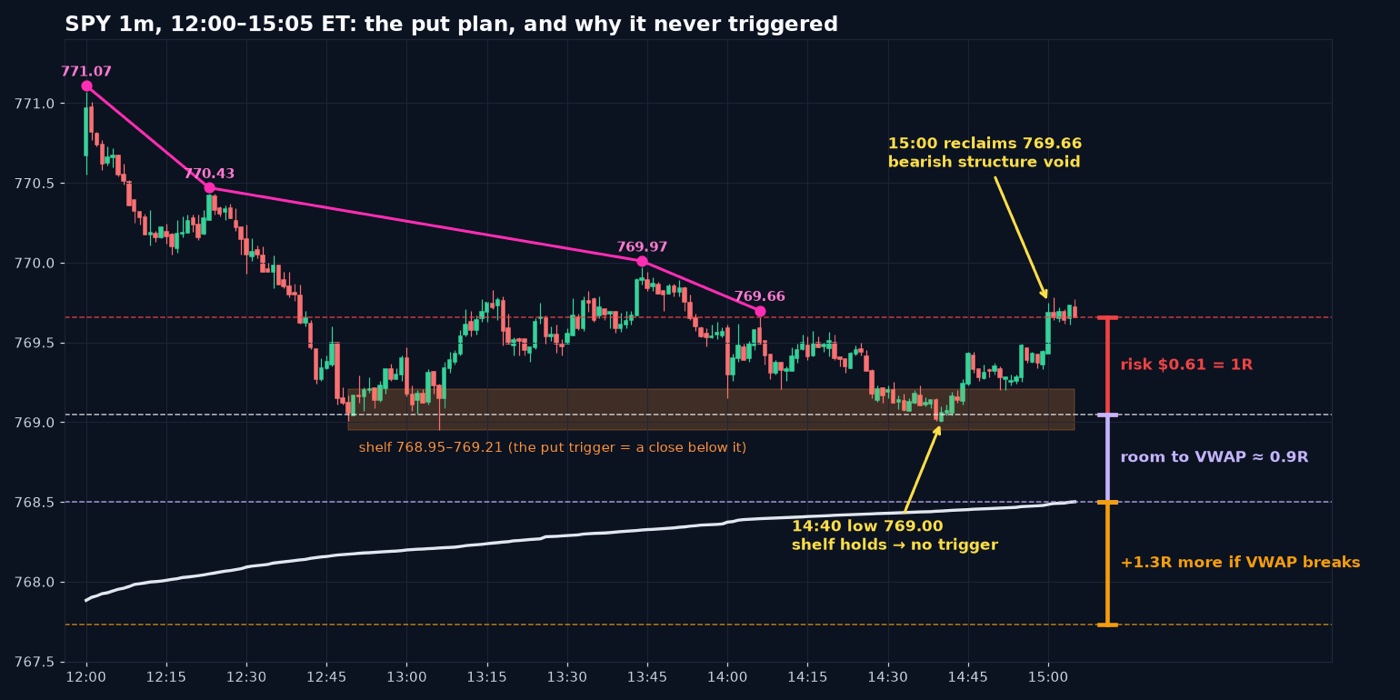
What actually happened. The shelf held. The low at 14:40 was 769.00, five cents above the trigger. No one-minute bar closed below 768.95. At 15:00, SPY rallied through 769.66, the last lower high, which cancelled the bearish structure. Price never drifted toward VWAP.
SPY 15m, 2026-10-27 (ET): bearish structure above VWAP, shelf holds, 15:00 reclaim
This is the right result for the framework, and it explains why the framework is built this way.
- VWAP did not block the trade. The binary rule would have ruled out the put before the chart had a chance to say anything. The hierarchy kept the put on the table.
- Price action did block it. The trigger was a close below the shelf, and the close never came. A trader who sold puts early, "because it's bearish and VWAP is a magnet," would have been stopped out at 15:00.
- VWAP's job was the plan, not the call. It set the first target and showed that the room, about 1R, was thin. That would have shaped the exit if the trade had fired.
VWAP Price Action Scalping Checklist
Run this in order before every M1 scalp:
- Structure. Is there a clear direction from swing structure (LH/LL or HH/HL), or a clean shift? If not, stop.
- Location. Is the setup at a level that matters: a range edge, PDH/PDL, PMH/PML, a tested shelf, or an FVG?
- Behavior. Is the level failing or holding, with a real candle: a close beyond it, a rejection wick, displacement?
- Trigger. What exact close fires the entry? Write the price down.
- VWAP state. Alignment, counter-alignment, target, or battle?
- VWAP distance. How many ATR from VWAP? If VWAP is on the path, how many R of room?
- VWAP weight. Has VWAP been respected today, or crossed freely?
- Plan. First target (VWAP if it is on the path), runner rule, stop at structural invalidation.
Frequently Asked Questions
Should I ever skip a trade because of VWAP?
Skip it because of room, not because of side. If VWAP sits between your entry and target with less than 1R of space, the trade risks more than it can make before the first likely reaction. That is a path-quality problem that VWAP reveals. Being on the "wrong" side of VWAP, with plenty of room, is not a reason to pass.
Does this apply to calls below VWAP too?
Yes, mirrored. A bullish structure shift well below VWAP, after a long flush, is state 3 for longs: VWAP becomes the first target above. A long just under VWAP needs VWAP to break first and deserves a breakout plan, not a mean-reversion one.
What about anchored VWAP or VWAP bands?
They are useful additions for location. Standard-deviation bands help quantify stretch, and an anchored VWAP from a major swing can act as a level. The same rule applies: they grade and target the trade; structure still picks the direction.
Is VWAP weight a tested edge?
No. The only tested part is the negative result: VWAP side as a yes/no gate adds nothing on M1 (n = 19,452). The four states, the room-in-R rule and the dynamic weight are planning discipline. Track them in your journal before trusting them with size.