Risk Management
Why Stocks Fall When Earnings Are Good: The Froth Model
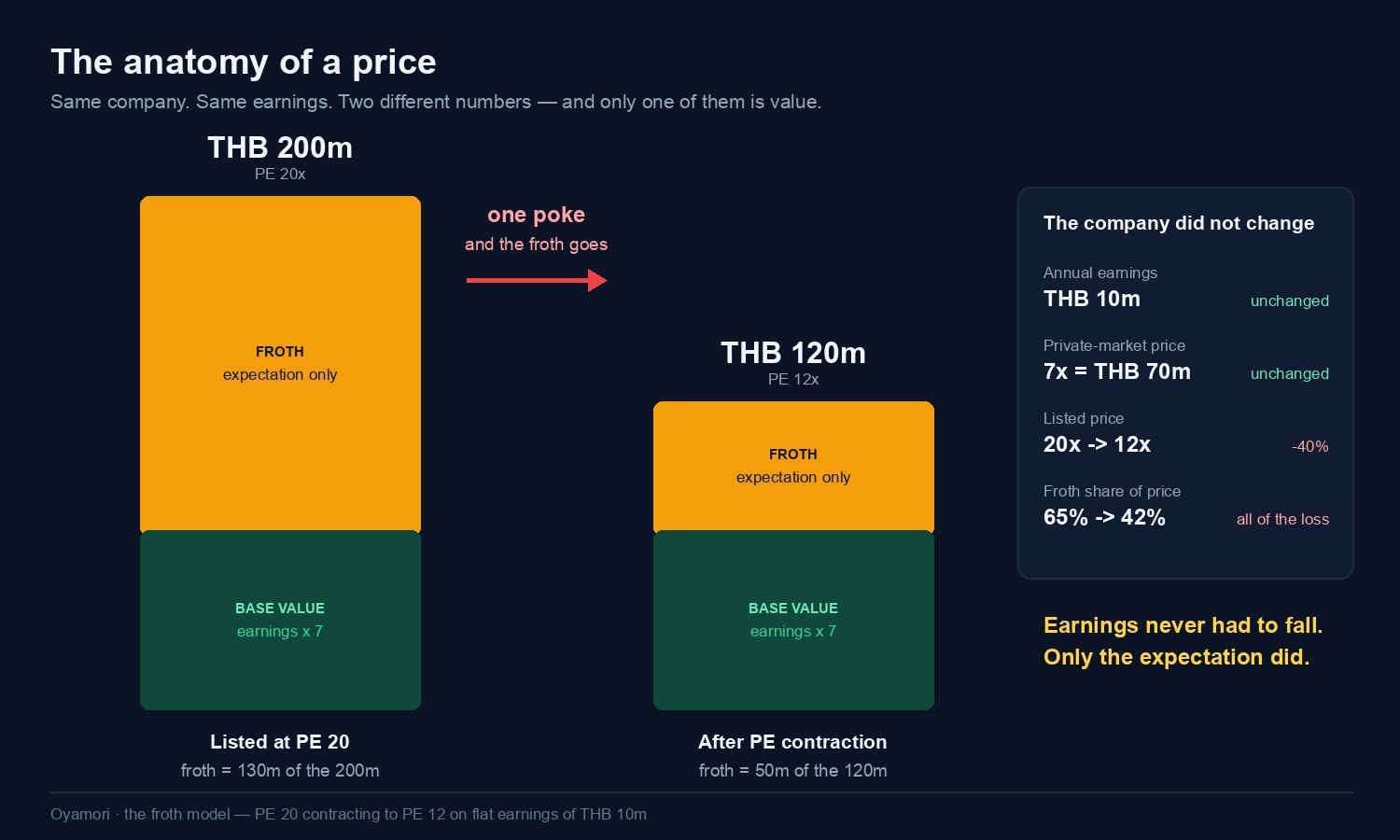
Why stocks fall when earnings are good is the question that breaks most people's mental model of the market. The company beat. Revenue grew. Margins held. The stock went down anyway, and kept going down. Nothing about the business explains it — because the part of the price that fell was never about the business.
There is a clean way to think about this, and the clearest version we have heard comes from Thai professional trader ธำรงชัย เอกอมรวงศ์ (Thamrongchai Ekaamornwong, "พี่หยง") in a long-form interview on bubbles, deleveraging and gold. He calls the excess part of a price "ฟู" — fluffed up, the way a cake rises. This article is our own explainer built on that model, with the arithmetic worked out and a real index drawdown to check it against.
The anatomy of a price: base value plus froth
Start where he starts, outside the stock market. He also buys unlisted companies, and in private deals a profitable business changes hands at roughly 6–8× earnings. A company earning 10 million a year is worth 60–80 million to a private buyer — someone acquiring the actual cash flows, with no liquidity, no index membership and no story attached.
List that same company and it trades at 20× earnings. Nothing about the business changed on listing day.
That 65% is the number worth sitting with. Two thirds of what you own in a 20×-multiple stock is other people continuing to feel the same way about the future. It is not a claim on anything. It is a mood, denominated in your currency.
Run it on a company you actually hold:
PE contraction: the price falls, the business does not
When froth leaves, the mechanism has a name — PE contraction, or de-rating. The market simply agrees to pay a lower multiple for the same stream of earnings.
This is why the earnings-were-fine objection misses. In his words the results were good — the large caps reported well, revenue grew, and the prices still could not hold. Good earnings protect the base. They do nothing at all for the froth, because the froth was never priced off earnings in the first place.
Here is what that looked like recently in the Nasdaq-100 proxy — a real drawdown with no earnings collapse behind it:
QQQ — an 11% drawdown with earnings intact (Jun–Sep 2026)
Peak close 744.21 on 3 June, trough close 661.73 on 29 July — −11.1% in eight weeks, then a recovery that has so far stalled around 709. No index-level earnings event marks that low. What moved was the multiple.
The tell before it deflates: acceleration without value
His answer to how do you see it coming is refreshingly unsatisfying: there is no formula. There is a set of symptoms.
- Price accelerating while nobody can defend the valuation. Traders know the stock is not cheap and the chart keeps going anyway. That is froth forming, not value being discovered.
- Hysteria in the feed. Everyone talking about the same names, all of the volume concentrated in them, no interest in anything else.
- The market cannot warn the majority. By construction — if most people got out in time there would be nobody to sell to. The move has to run until participants are dazed.
- Levels that do not hold. Prices can print 200, 500, 1,000 — but froth cannot stand at a level, so the number is touched and lost rather than held and built on.
Leverage is not the villain — the assumption behind it is
This is the part most risk articles get wrong, and he is blunt about it: leverage is a tool. Gearing of 400–500% is not, by itself, evidence of recklessness; there are professional books that run there permanently and survive.
What kills is a belief that rides along with it: the market will always give me another opportunity. Hold that belief and every setup becomes worth taking, every dip worth adding to, and the leverage that was sized for your best three ideas a year is now spread across thirty mediocre ones.
| Leverage as a tool | Leverage as a habit | |
|---|---|---|
| Held by | someone counting opportunities | someone counting opportunities they might miss |
| Sizing | fixed to a small number of high-conviction ideas | expands to fill available margin |
| Spare capacity | kept unused most of the time | always deployed |
| On a drawdown | has room to survive it | forced to sell at the worst price |
| Mental state | bored, most of the time | excited — the gambler has arrived |
He has a phrase for the transition: it turns a person who watches risk into ผีพนัน — a gambling spirit. And the mechanism is not stupidity, it is success. You see profit, you see others making more, you still have buying power, so you top up. Each individual decision is defensible. The stack of them is not.
If you want the arithmetic of how that stack ends, we wrote it up in how a margin call cascade actually unfolds and risk of ruin.
Maximise comfort, not return
The line from the interview worth writing on the wall: maximise ความสบายใจ — peace of mind — not maximise return.
It sounds soft. It is actually a position-sizing rule with teeth, because it inverts the default question. Instead of what is the most I can hold, it asks what is the most I can hold and still behave correctly when this goes against me. Those are different numbers, and only the second one survives contact with a real drawdown.
The practical expression of this is the free position: when a winner has run, sell enough to recover your original cost. What is left has none of your money in it, so a drawdown cannot force you out of it, and the recovered capital is available for the next thing.
Cash and gold are positions, not the absence of one
Two of his conclusions follow directly from everything above.
Cash is a position. He held cash deliberately waiting for a correction rather than staying fully invested — which cost him upside for months and then paid when the de-rating came. The froth model makes the case: when most of a price is expectation, the option to buy after the expectation resets is worth holding, and it only exists if you kept the capital.
Gold, chosen partly for its simplicity. His case for gold as a long-horizon holding is not a chart pattern. It is that as everything else grew more complex — structured products, leveraged single-stock ETFs, AI-driven flows nobody can model — gold stayed something you can understand, price and own outright. Complexity is a risk in its own right, and simplicity is a feature you can buy.
Does the froth model mean high multiples are always wrong?
No, and treating it that way will keep you out of every good business of the decade. A company compounding earnings at 25% a year genuinely deserves a higher multiple than one growing at 3%, and paying 20× for the first can be far better value than paying 8× for the second. The model does not tell you a multiple is unjustified — it tells you how much of your position depends on that justification continuing to be believed. A 65% froth share is not a sell signal. It is a statement about what you are exposed to, which is the mood of other buyers, and it should drive your size and your leverage rather than your opinion of the company.
How is this different from just saying "the market is overvalued"?
"Overvalued" is a verdict with no number attached and no action implied — people have been saying it continuously for a hundred years and it tells you nothing about what to do on Monday. The froth model is arithmetic: it names a base multiple, computes what share of today's price sits above it, and prices the specific de-rate you are worried about. That produces sizing decisions rather than opinions. It still cannot tell you when, and anyone who says their version can is selling something.
What is actually changing: the edge is eroding
The most uncomfortable section of the interview has nothing to do with valuation. His point is that the trader's traditional edge was patience — the discipline to wait for a price that was genuinely wrong, and the willingness to pass when it never came.
That edge is thinning for two reasons. Everyone now has the same data, so information advantage has largely gone. And the market moves faster: corrections that used to arrive once every twelve to eighteen months now come in clusters, and a pullback that once gave you a week to accumulate gives you an afternoon. The old response — wait calmly for the right price — increasingly means missing the trade entirely, which pushes even patient people into chasing.
His conclusion is one worth taking seriously whatever your method: models that worked in the past must be watched carefully, because some of them are quietly expiring. That is the same discipline we apply to our own signals — a strategy is a claim with a sample size, not a possession, which is the whole argument in what a trading edge actually is.
The takeaway
Before your next position, do the split:
- Name the base. What multiple would a private buyer pay for these earnings? Six to eight times is the honest anchor for an ordinary business.
- Measure the froth. Everything above that is expectation. Above roughly 60%, most of your position is somebody else's mood.
- Size for the de-rate, not the earnings. Ask what a move from today's multiple to a normal one costs you, and whether you can hold through it without being forced to act.
- Take the cost off the table when a winner runs. Trade some expectancy for the ability to keep holding.
- Treat cash as a position. The option to buy after a reset only exists if you kept the capital to use it.
Good earnings will not save a price that was mostly expectation. That is not a market failure — it is the market repricing the part that was never earnings in the first place.