Edges
Long Lower Wick in an Uptrend: Reading a Sell-Side Liquidity Sweep
A long lower wick in an uptrend is one of the most misread candles in trading. Price is climbing, then a single bar stabs violently lower, your Call premium craters, you panic-sell — and price immediately reclaims and runs without you. That wick wasn't a reversal and it wasn't random. In almost every case it is a sell-side liquidity sweep: price traded into a pool of resting sell orders, absorbed them, and rejected higher. This article explains exactly how that wick is built, how to tell a real sweep from a genuine breakdown, and why short-dated options traders get hurt by it more than anyone.
First, the naming, because it matters: you don't need a new term for this candle. "Panic wick" describes the feeling, but the wick is just the shape an event leaves behind. The event has a standard name in SMC/ICT — a sell-side liquidity sweep, or stop-hunt wick — and treating it as the known concept keeps your framework clean. For the broader mechanic, start with liquidity sweep trading; this piece zooms all the way into the single candle.
How the long lower wick is actually built
The wick is not one thing happening — it's a six-stage sequence. Step through it:
In order: a clean uptrend forms an obvious Higher Low; longs trail their stops just under it; price dips into that cluster; the stops fire as market-sell orders; passive buyers absorb the flood; and with no follow-through, price reclaims and closes back above the level. The candle that prints is a long lower wick. The same chain as a flow diagram:
The mental-model fix: nobody "sees" your stop
It's tempting to think smart money opens the order book, spots "50,000 shares of stops at 134.10," and drives price there to grab them. That's not how it works — and getting this right makes you a better trader.
Stop-losses are conditional liquidity, not resting liquidity. A resting limit order sits visibly in the book. A stop-loss is invisible until it triggers — then it fires as a market order. So institutions and algos can't read your stops. What they can do is estimate: an obvious Higher Low is visible to everyone, longs will protect below it, breakout sellers will pile in on a break — therefore the probability of liquidity below that level is high. Not "38,420 shares at 134.10," just "liquidity likely here."
| Resting liquidity — visible | Conditional liquidity — hidden | |
|---|---|---|
| Type | Limit orders | Stop-losses |
| On the book | Yes, before it trades | No — fires only when hit |
| Smart money | Can see it | Estimates it, can't read it |
| Example | Sell limits stacked at a price | Trailed stops under a Higher Low |
This is the same lesson as the smart money algorithm: the market reconstructs probable liquidity from structure and predictable behaviour — it doesn't need a villain with x-ray vision. Price simply traded into an area holding sell-side liquidity, the liquidity got consumed, buyers overwhelmed the remaining sellers, and price rejected. No single hunter required.
What it looks like live — SPCX on the A+ Scalp
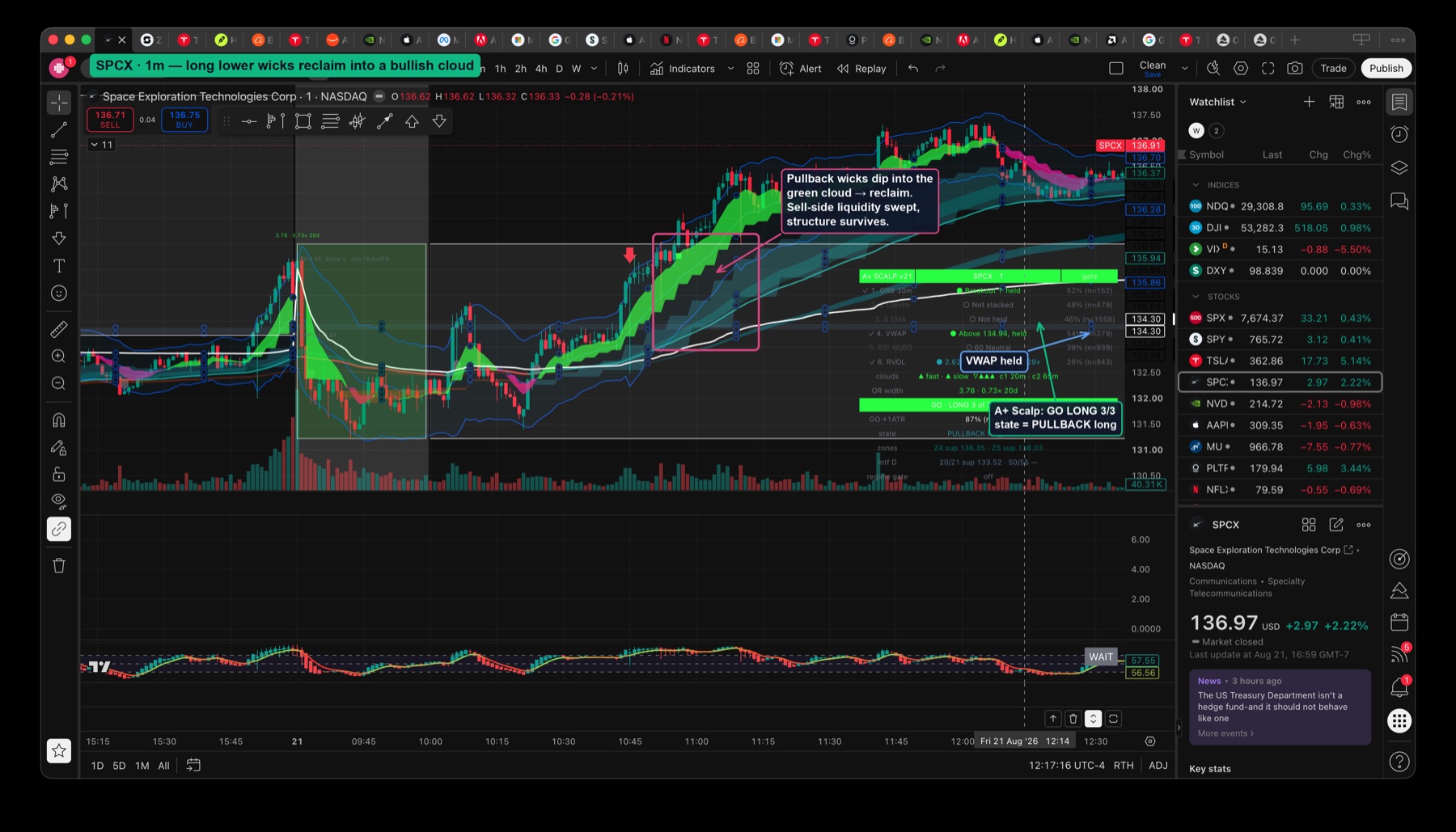
Here is the exact behaviour on SPCX. On the 1-minute, price is in a confirmed bullish structure (green fast cloud, VWAP held, RVOL expanding, the A+ Scalp reading "GO LONG 3/3"). Each pullback wicks into the cloud and reclaims — sell-side liquidity swept, structure intact:
Step up to the 5-minute and the same wick sits inside a confirmed-long trend — the higher timeframe context that tells you the dip is a sweep to buy, not a breakdown to fear:
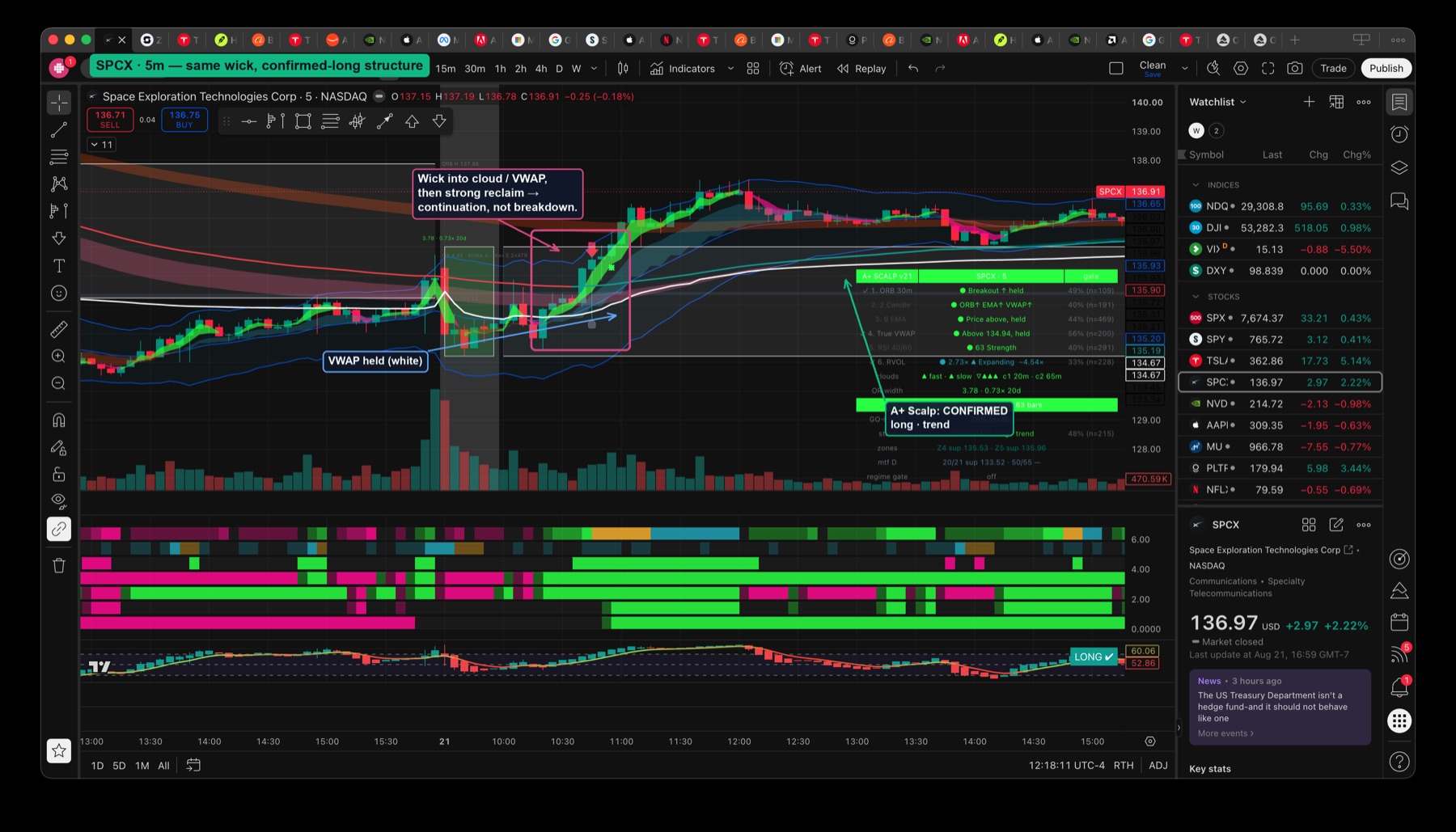
Reading the wick on the entry timeframe alone is how you get faked out. Anchored to the higher-timeframe structure, it's a textbook sweep-and-go — the core of multi-timeframe entry.
The one decision that matters: reclaim vs acceptance
The sweep is not the signal — what happens after it is. Same wick to the same level, two opposite trades:
- Reclaim — price pierces the level, absorbs the stop flow, and closes back above. That's rejection. The bullish thesis is intact — this is the "stop hunt then go" you were waiting for.
- Acceptance — price goes below the level and stays there, building lower highs beneath it. That's a real breakdown. The idea is invalidated.
Toggle the two and watch the same setup resolve in opposite directions:
The tell is the close relative to the level, not the intrabar spike. Never judge the wick while the candle is still forming — a reclaim is only real once the bar closes back above. Here's the reclaim case as a schematic: wick pierces the swept level, closes above, continues:
Sweep the level → reclaim on the close → continuation
The wick on Aug 6 stabs to 133.70 — under the 134.10 Higher Low — then closes at 134.80, back above it. Sweep, reclaim, continuation. Had it closed at 133.70 and kept making lower highs, that's acceptance, and you'd be exiting, not adding.
Why this candle wrecks options traders
If you trade the underlying, a long lower wick is a scare. If you hold a short-dated Call, it's a bloodbath — for a purely mechanical reason. The underlying dips maybe 0.6% into the wick, but delta and gamma multiply that into a huge premium swing, so your Call looks like it's collapsing. You sell at the low; the reclaim then rockets the premium back — without you. Pick an expiry and see the same 0.6% wiggle hit your Call:
The shorter the expiry, the more gamma turns a nothing dip into a heart-attack — which is exactly why 0DTE and 1DTE Call holders panic-sell sweep wicks that a swing trader wouldn't even notice. The fix isn't a tighter stop; it's knowing in advance that a sweep into obvious liquidity is likely, and pre-deciding to judge the close, not the spike.
Holding through the wick — the checklist
Turn all of this into a repeatable read so the next scary wick is a setup, not a stop-out:
- Structure — is the higher timeframe still clearly bullish (higher highs, higher lows, cloud/VWAP held)?
- Location — is there an obvious Higher Low / equal lows just below price for stops to cluster under?
- The wick — did price dip into that pool and reject, or grind through it?
- The close — reclaim (closes back above the level) or acceptance (closes and stays below)?
- Follow-through — after the reclaim, does price push on and hold, confirming the sweep?
Reclaim with structure intact — the thesis lives, and the wick was liquidity being consumed. Acceptance below the level — the thesis is done, and no amount of hoping brings it back. That single distinction, applied on the close, is the whole edge. It's the same discipline as when to enter a long and the sweep step in the SMC/ICT checklist.