Edges
Multi-Timeframe Entry: Premium, Discount & the Right Moment to Buy
Multi-timeframe entry is where most "good setups" quietly go wrong: the higher timeframe says buy, the lower timeframe you actually click from says the opposite, and you never notice the contradiction until the stop is hit. The single most useful skill in smart-money trading is reading where price sits inside its range on each timeframe at once — because the same candle can be a deep discount on the 1-hour and an expensive premium on the 10-minute. This lesson shows you how to stack those readings and find the one spot where they agree, so you enter with the market instead of against a tier of it.
This is the entry-timing companion to the full SMC multi-timeframe analysis blueprint — that one builds the top-down framework; this one zeroes in on the exact question, "given all my timeframes, is this price a good place to buy?"
The same price is two different places
Here is a live contradiction from an ETH chart. The 1-hour read the price at 18% of its range — deep discount — with bias rotating bullish. At the very same second, the 10-minute read the same price at 69% of its range — premium, near the top of its micro-move. Both were correct. They are just measuring different ranges.
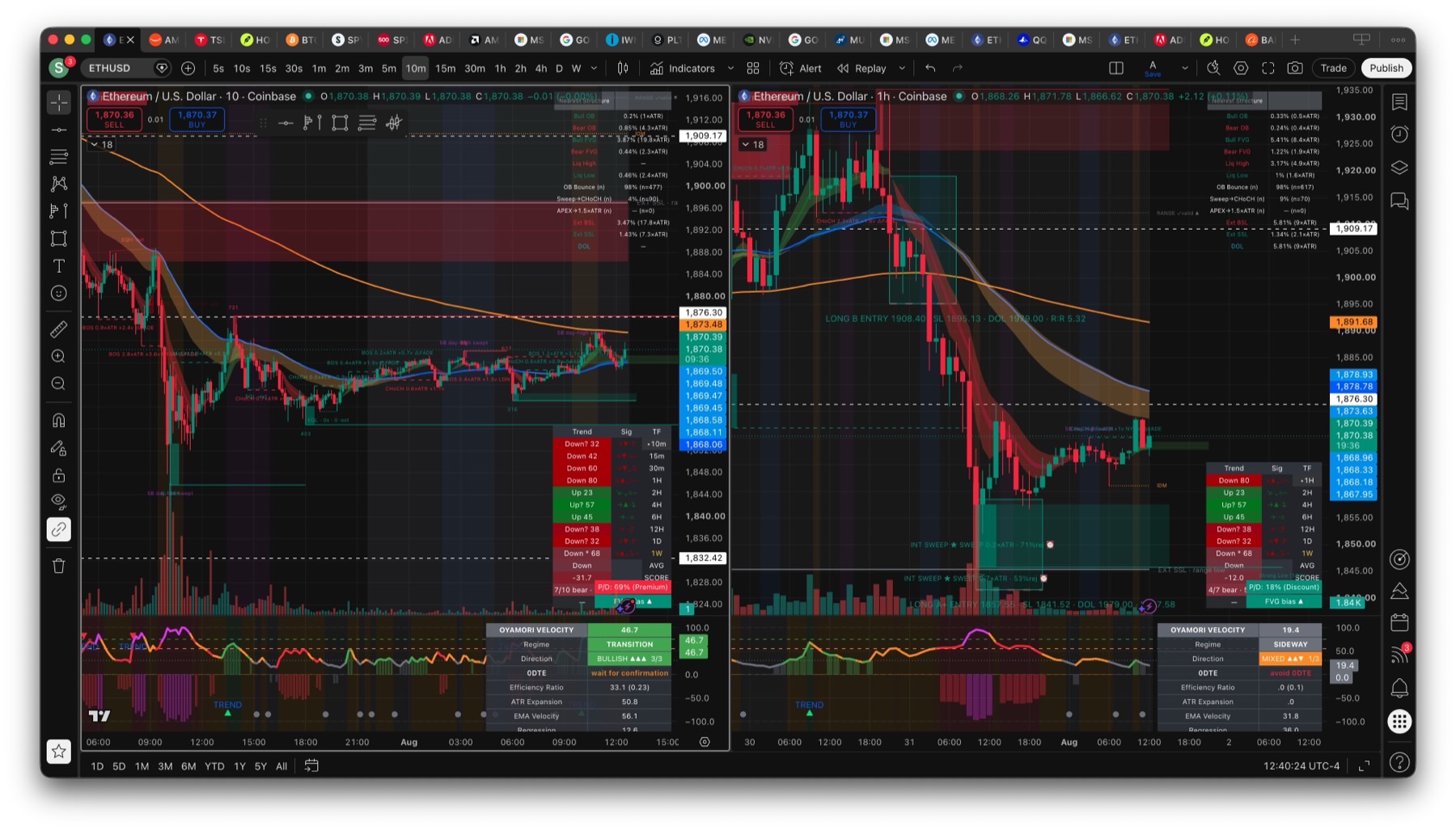
This is the trap that ruins multi-timeframe entry: a trader sees "1H discount, bias up" and buys immediately — but the price they buy is sitting at the top of the lower-timeframe range, so they are long right into a pullback. The location that matters for timing is the lower-timeframe one; the location that matters for bias is the higher one. Flip the scenarios and watch the verdict change:
Premium and discount are not opinions — they are simply which half of the current range price is in. Above the 50% midpoint (equilibrium) is premium, the expensive half where smart money sells. Below it is discount, the cheap half where smart money buys. The whole game of entry timing is: buy discount inside a bullish higher timeframe, sell premium inside a bearish one — and never confuse the two ranges.
What premium and discount actually mean
Every swing high to swing low defines a dealing range. Split it in half and you get equilibrium — the 50% line. That single line reframes every entry:
- Discount (0–50%) — the lower half. In a bullish market this is where longs belong. Buying here means buying below fair value.
- Equilibrium (~50%) — fair value. No edge either way; the worst place to enter because your stop and target are equidistant.
- Premium (50–100%) — the upper half. In a bearish market this is where shorts belong. It is also where longs get trapped.
The sharpest long entries cluster in the 0.62–0.79 discount pocket — the same zone Fibonacci traders call the OTE / golden pocket. It is not magic numbers; it is just deep discount inside the draw on liquidity. The higher timeframe tells you which direction the draw points; premium/discount tells you whether the current price is a bargain or a rip-off relative to that draw.
The ladder: bias tiers vs timing tiers
Stack your timeframes and each one votes a direction. The trap is treating all votes as equal. They are not: the higher timeframes own the bias, the lower timeframes only own the timing. A bearish 1-minute inside a bullish 4-hour is not a sell signal — it is a discount being handed to you.
Tap the rungs to flip them and watch how the bias (top of the ladder) and the action (does the bottom agree?) resolve. The preset is that same ETH read — a bearish lower-timeframe stack sitting inside a higher-timeframe discount:
When the top and bottom of the ladder disagree, you have exactly two honest choices: wait for the lower timeframes to rotate into agreement with the bias, or stand aside. What you never do is take the lower-timeframe signal against the tiers above it — that is the definition of counter-trend gambling dressed up as a "signal."
The alignment rule — three tiers must agree
Turn the whole thing into one gate. Three questions, and the answer is only GO when all three line up:
- HTF bias — is the higher timeframe bullish, bearish, or unclear?
- Price location — is price in discount, equilibrium, or premium of the HTF range?
- LTF trigger — has the lower timeframe actually confirmed (a CHoCH / MSS), or is it still forming?
Set each tier and read the verdict. Notice that "bias up + price premium" is a WAIT, not a GO — the exact ETH situation:
This is why two green lights and one grey is still not a trade. The framework is deliberately strict, because the cost of a missed trade is zero and the cost of a wrong one is real. Most losing trades are not bad ideas — they are good ideas fired one tier too early.
The good spot to enter, on a chart
Put it together. Here is the dealing range with its equilibrium and discount/premium halves marked. Price falls into discount, sweeps the low, reclaims, and only then — from the discount, in agreement with a bullish bias — is it a long. The entry is not the touch of discount; it is the sweep-and-reclaim inside it.
The Entry Is Discount + Sweep + Reclaim — Not the Touch
Read it left to right: price is expensive in premium, rolls down through equilibrium into discount, sweeps the discount low and reclaims, displaces back up through equilibrium (a bullish structure shift), pulls back to retest — that is the long — and expands toward the premium draw. The bias tier said up; the discount location said cheap; the reclaim was the trigger. All three agreed at one price.
Worked example — the real ETH read
Back to the live chart that opened this lesson. Here is exactly how the alignment rule resolved it:
| Tier | Reading | Verdict |
|---|---|---|
| HTF bias (1H) | 18% discount, rotating bullish, draw on liquidity above | ✓ bias up, right half |
| Timing (10m) | 69% premium, already rallied to the micro-top | ✗ wrong half for a fresh long |
| Trigger (1m/5m) | no confirmed structure shift; chop, efficiency near zero | ✗ nothing fired |
Two of three said "not yet," so the honest call was wait — not because the idea was wrong, but because the price was at premium on the tier you enter from. The good long was not at that moment. It was one of two later spots:
- Deep-pullback long — let the 10-minute fall from premium back into its own discount, into the 1857–1865 demand (which is also where the higher-timeframe order block sits), sweep-and-reclaim there, then long toward the draw. Stop below the swept low.
- Break-and-retest long — wait for the 1-hour to actually shift structure up (close above the protected high at ~1908), then buy the retest. Later, but confirmed.
Either way the entry waits for discount on the timing tier to line up with the bullish bias tier. Buying the 69% premium because "the 1H is discount" is the exact error this whole framework exists to stop.
What happened next — the coil broke down
A few hours later that coil resolved. Not up — down. Price broke the range low, swept the sell-side, and expanded straight to 1835 on a bearish momentum burst:
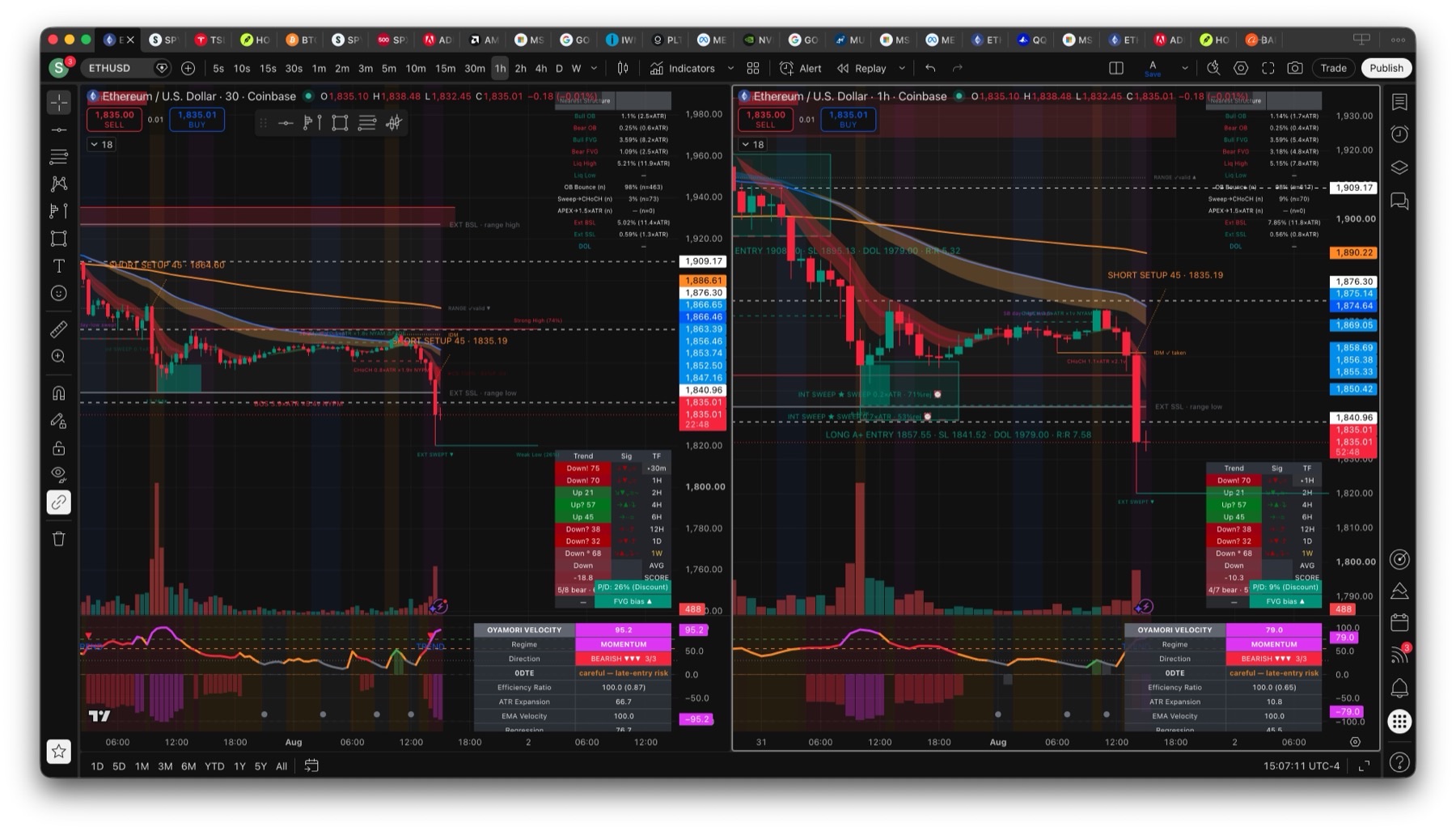
This is the most important nuance in the whole lesson, and the market just demonstrated it live: discount is necessary, but not sufficient. A deep discount reading during a bearish momentum breakdown is not a bargain — it is a falling knife. The price got cheaper precisely because the bias was down. Cheap-and-getting-cheaper is a downtrend, not a discount to buy.
Watch what the alignment rule protected you from:
- The trader who bought the earlier "1H is discount, bias up" idea at ~1857 got stopped at 1841.52 when the range low broke. Discount touch, no confirmation, dead.
- The trader who waited for the stack to agree — discount and a bullish LTF trigger — simply never entered. Nothing confirmed to the upside, so no trade, no loss.
That is the entire payoff of multi-timeframe entry: the discipline that keeps you out of a "cheap" long is the same discipline that keeps you out of a knife. A discount only becomes a buy when the bias tier and a lower-timeframe trigger both agree with it — and here they never did.
Aggressive versus conservative, across timeframes
The same two speeds from the short-side and long-side entry lessons apply here, now filtered through the ladder:
- Aggressive — take the lower-timeframe trigger the moment it fires inside HTF discount, before the higher timeframe fully confirms. You get a better price and a tighter stop, at the cost of more failed attempts. Only valid when the LTF is confirming toward the HTF bias, never against it.
- Conservative (recommended) — wait for the higher timeframe itself to shift structure, then buy the retest. Fewer trades, far higher hit rate, and you are never fighting a tier.
Aggressive means front-running the confirmation, never front-running the bias. The moment your entry disagrees with the top of the ladder, it is not aggressive — it is wrong.