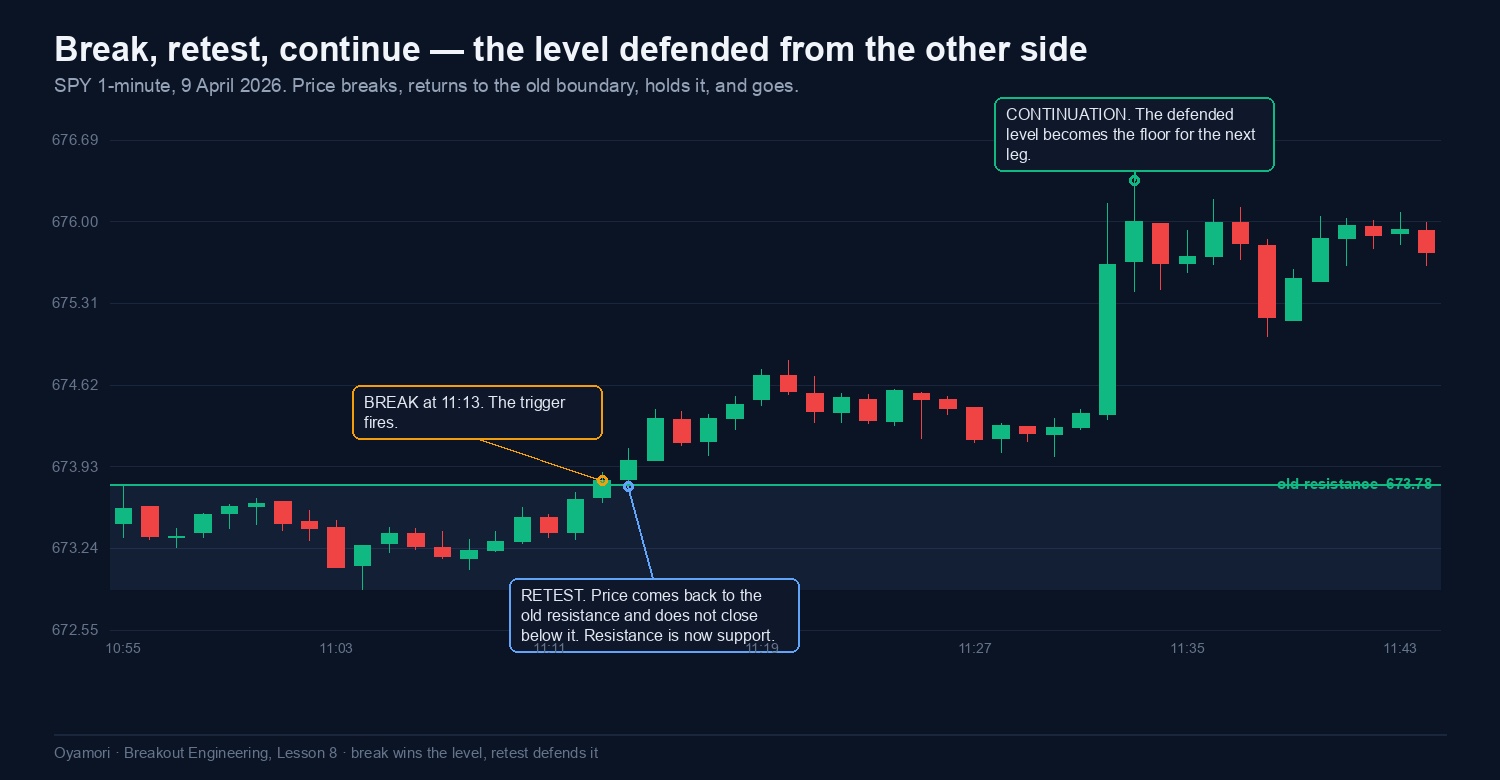
Price cleared the boundary, ran for a few minutes, and is now drifting back toward the level it broke. Every breakout course calls what happens next the disciplined entry: wait for the return, confirm the level holds, enter with a tight stop. The advice is sound and incomplete at the same time, because the return is not a confirmation you are handed. It is an experiment the market runs on its own pricing, and it can come back negative.
What a retest actually tests
The break established one fact: buyers could clear the boundary once. The retest asks a different question. Now that the level has been taken, will anyone defend it from the other side?
Those are separate propositions. Clearing a level requires enough demand to consume the resting supply once. Defending it from above requires standing demand — someone willing to bid at that price on an ongoing basis. A market can do the first and fail the second, and that combination is what a failed breakout is.
break:   proves demand existed at one moment
retest:  proves demand exists as a standing condition
That tells you what to watch during a retest, and it is not the price. It is whether anything happens at the level: does volume pick up, do the bars change shape, does the decline stop with a wick or with a grind. A retest where price drifts down and sits there with nothing happening is a failing retest before it has broken anything.
Why the old boundary flips sides
The auction explanation from the acceptance lesson is that the old boundary becomes the lower edge of the new value area. The order-flow version is more useful at the desk.
Before the break, the boundary carried resting sell limits. Those were consumed or pulled during the break, and the level is now bare. Afterwards, three groups place orders at or near that price, and all three place buy orders.
Shorts who covered during the cascade treat the old resistance as a reference point, and some flip long and bid there. Traders who missed the break are the largest group: they watched the level go, hesitated, and want in at a better price, and the old boundary is the only landmark nearby. Traders who bought the break and want to add are the smallest and most disciplined, and they wait for a rejection wick.
before break:  sell limits, responsive sellers defending
during break:  consumed or cancelled
after break:   buy limits, from missed-the-break, covered shorts, adders
Resistance does not become support because the chart remembers. It flips because the population of orders at that price has been replaced. It is a different level that happens to sit at the same number.
That mechanism carries a consequence: the flip needs time for the new orders to arrive. A return fifteen seconds after the break gets there before the missed-the-break crowd has entered anything, and it tests an empty level. Treating anything inside roughly two minutes as part of the impulse rather than as a test is order-flow reasoning, not something we have measured.
Shallow, normal, deep
Depth is how much of the impulse the pullback gives back: impulse high down to pullback low, divided by impulse high down to the broken boundary.
| Depth | What it means | Entry quality | The catch |
|---|---|---|---|
| Under 40% | Buyers would not let price back | Poor, barely available | Strongest breaks, worst entries |
| 40–75% | Healthy test, workable stop | Good | The band worth waiting for |
| 75–100% | Back to the boundary zone | Excellent geometry | Gave it all back: weak support |
| Over 100% | Below the invalidation level | None | An invalidation, not a retest |
The awkward part is the diagonal. The deepest retests give the tightest stop and the best reward-to-risk on paper, and they are the ones where the new level was least defended. The shallowest are the strongest signal and the hardest to trade, because they never come back far enough to fill you. The middle band is a compromise, not an optimum.
That ranking comes from trade logs, not from our SPY study. We have not measured continuation by retest depth, so treat the bands as a frame to re-measure on your own instrument rather than as a result.
Valid retest, failed retest
The rules, stated so you could code them:
valid retest requires:
    at least 2 minutes since the break
    pullback low stays above the invalidation level
    volume declining versus the impulse
    a rejection bar: close in the upper half of its range
    then: a later bar takes out the rejection bar's high

failed retest:
    close back below the invalidation level
    OR volume rising on the way down
    OR three or more bars at the level with no bounce
Two of those carry most of the weight. Declining volume on the way back is close to diagnostic: a healthy retest is quiet, an absence of buying rather than a presence of selling. Rising volume into the level is supply arriving, and the level is about to go.
And the trigger is the bar taking out the rejection bar's high, not the touch of the level. Waiting for the turn costs a few cents and removes the case where price reaches the level and keeps going. If you accept the delay of waiting for a retest, take the confirmation the delay buys you.
A retest is a stress test, and stress tests fail
Here is the part the standard teaching leaves out. The retest does not sit outside the failure statistics. It sits inside them, in the same minutes where failures declare themselves.
Across 490 SPY sessions and 489 first breakout attempts out of compressed ranges, 09:45–14:30 ET, the median time to a confirmed failure was 4 minutes (p25 2, p75 9). The retest window and the failure window are the same window. A retest that dips back inside and stays there is not a separate event from a failed breakout — it is the failure arriving a few minutes later than the ones that never left.
And the number you get depends on where you draw the line.
Under our working definition — two consecutive closes back inside — a deep retest that pokes into the old range for two bars before turning is counted as a failure, even if price later makes new highs. Under the strictest definition a single close inside does it, and the rate rises to 83%. Measured a third way, by whether price was still inside the range at the 30-minute mark, the figure is 47%.
None of those numbers is wrong. They measure the same 489 attempts with three different tolerances, and a deep retest is the kind of event that lands in the gap between them. The definition you choose moves the observed failure rate across a 47–83% span, and it decides whether you are still holding the position. Our study of the 489 attempts has the breakdown; costs are not included in any of these figures.
Does that mean a deep retest is a bad trade?
No — it means a deep retest and a marginal failure look identical while they are happening, and no rule separates them in real time. Exit on two consecutive closes back inside and you will be taken out of some retests that would have worked. Loosen it to give deep retests room and you will hold genuine failures longer, which on a decaying option costs more than the trades you saved. No setting avoids both. Pick the tolerance that matches your instrument, write it down before the session, and stop renegotiating it while a position is open.
Break wins the level; retest defends it
The phrase is worth carrying, because it sets out what each event proves and what it does not.
| Event | What it proves | Confidence |
|---|---|---|
| Break | Demand cleared supply once | Moderate |
| Shallow pullback held | Demand standing but untested | Small increase |
| Normal retest held | Demand defends the level | Large increase |
| Retest failed | Level offered and refused | Large decrease |
| No pullback at all | Demand overwhelming, level untested | Large, but no entry |
The fourth row is the one traders underweight. A failed break might have been a sweep, a probe, or noise. A failed retest means the market was offered the new level at a discount and declined it — a stronger negative signal than the original break was a positive one.
The last row is the argument against making the retest your only entry. A move that never gives anything back tells you demand is enormous and hands you nothing to act on. The strongest moves are the ones least likely to offer a retest, so a retest-only rule does not merely cut your trade count, it biases what remains toward the weaker half. That reasoning is mechanical rather than measured on our sample, but it follows from the same asymmetry the depth bands describe.
What you should take from this lesson
- The break and the retest test different things. The break proves demand existed once; the retest proves it exists as a standing condition. A market can pass the first and fail the second.
- The level flips because its orders were replaced, not because the chart remembers — and that repopulation takes time, so a return inside two minutes tests an empty level.
- Depth is a trade-off, not a ranking. Deep retests give the best geometry and the weakest evidence; shallow ones the strongest evidence and no fill.
- A retest is a stress test, and it lives inside the failure statistics. Median time to a confirmed failure across 489 attempts was 4 minutes — the window the retest occupies.
- The definition sets the number. 75% failed on two consecutive closes back inside, 83% on any close, 47% still inside at thirty minutes. Choose one before you enter.
Next: the structure vocabulary — sweeps, change of character, break of structure — and why those reads arrive earlier than the moving-average and volume confirmations most traders wait for.