Ask most traders to define a breakout and you get a four-second answer: price closes above resistance. It is not wrong, it is just useless — it describes one bar and tells you nothing about what to do, how much to hold, or when you were wrong.
This lesson replaces that definition with one you can trade from.
What a breakout is at the level of order flow
A range exists because two groups agree. Buyers will not pay above a level; sellers will not sell below one. Both sides have resting orders — and crucially, both have stops parked just beyond the extremes, because that is the only place a stop is safe from normal rotation.
When price finally clears the upper extreme, a specific mechanical chain fires:
Notice what is missing from that chain: any check on whether real supply is waiting higher up. The stops trigger regardless. The book is thin regardless. The algorithms fire regardless.
You do not have to know whether it is real
Here is the claim that reorganises everything, and it is the one people push back on hardest:
The impulse happens whether or not the breakout is valid.
A fake breakout and a real one look identical for the first thirty to ninety seconds, because in that window they are the same process. They diverge afterwards — one finds no supply and continues, the other runs into size, gets absorbed, and reverses.
If the first segment is common to both outcomes, then a trader who captures only the first segment is trading a far higher-probability event than one who needs the correct outcome.
P(impulse | boundary breaks with real conditions)      ≈ high
P(continuation | boundary breaks with real conditions) ≈ moderate

Trading the impulse       → betting on a mechanical event
Trading the continuation  → betting on a discretionary outcome
Most breakout traders are unknowingly betting the second line while believing they are betting the first. They enter on the break, hold the whole position, and their P&L ends up determined entirely by continuation — while the impulse, the part that was nearly certain, passes through the account without ever being converted into money.
What that looks like on a real chart
This is a genuine SPY breakout from a genuine compressed range on 20 March 2026, and a genuine failure five minutes later.
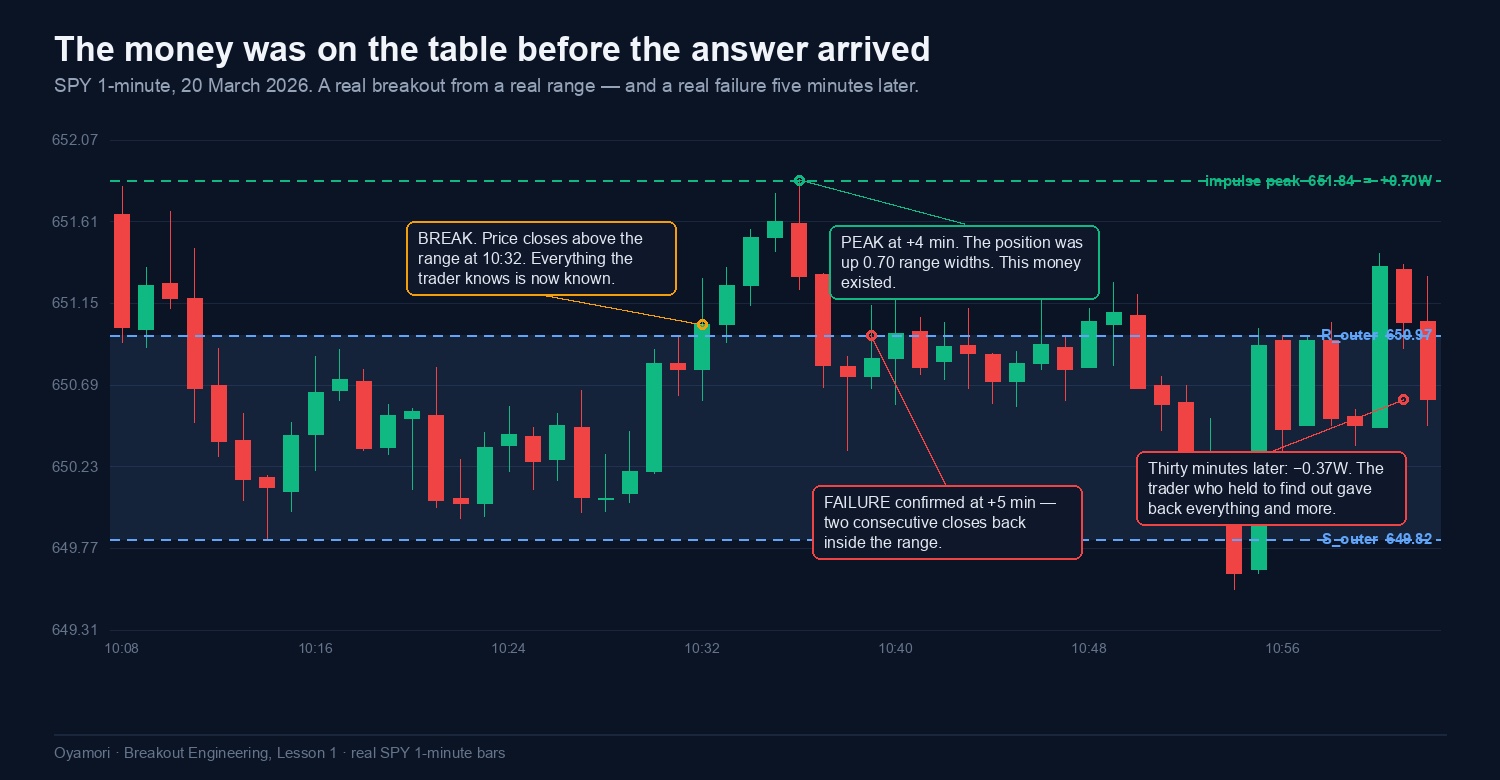
The position was up 0.70 range widths four minutes after the break. Then it failed, and thirty minutes later it sat at −0.37. Nothing about that sequence is unusual. The money existed; it was not taken, because the trader was waiting to find out whether they were right.
We measured how typical that is across 489 breakouts, and the answer is in what 489 real breakouts did: failures still reach a quarter of the range width about half the time, in a median window of four minutes.
The reframe, stated properly
The question is not "is this breakout real?"
The question is "how much has the market proven so far, and what should my position be at this exact level of proof?"
That question has an answer at every moment, and the answer changes as evidence arrives. Position size stops being a single bet placed at the start and becomes a function of proof.
| Evidence so far | What has been proven | Appropriate exposure |
|---|---|---|
| Compression detected | A range exists and is tightening | None — watching |
| Boundary pressure building | One side is being pushed | None — armed |
| Boundary clears | The stop cascade is underway | Full initial position |
| Impulse extends | Momentum participation confirmed | Take the first profit |
| Price holds outside | Acceptance forming | Reduce again, protect |
| Retest holds | The old boundary has flipped | Runner only, or add |
| Structure breaks | The thesis is dead | Zero |
Nobody trades this way when they first learn breakouts. Most people arrive here after enough of them.
Walk the states and see what each one does and does not permit:
What this costs you
Honesty about the trade-off, because the method is not free.
- You will never catch the whole move. Taking profit into the impulse guarantees you leave money on the runners. That is the premium you pay for being paid on the three attempts in four that fail.
- It requires more decisions. One entry and one exit is simpler than a staged campaign. If you cannot execute a plan under pressure, the extra decisions will cost more than they earn.
- It needs at least two contracts or two units to exist at all. With one, you can harvest or you can participate — never both.
What you should take from this lesson
- A breakout is a sequence of states, not a candle crossing a line.
- The impulse is mechanical — resting orders being released — and it fires in both outcomes.
- Continuation is discretionary — it depends on supply you cannot see.
- Therefore: trade the mechanical part, and let the discretionary part be a free option paid for by the first.
Next: compression — where the move is built, and why a tight range makes the impulse bigger without making the breakout any more likely to work.