Nobody is hunting your stops. Your stops are the most predictable liquidity in the building, and somebody needs liquidity. That single reframe explains almost everything in this lesson, including why the failure you are about to be shown is a mechanism rather than a misfortune — and why, on our sample of 489 SPY breakouts across 490 sessions, 75% of attempts ended back inside the range.
Three verdicts, and which part of the candle delivers each
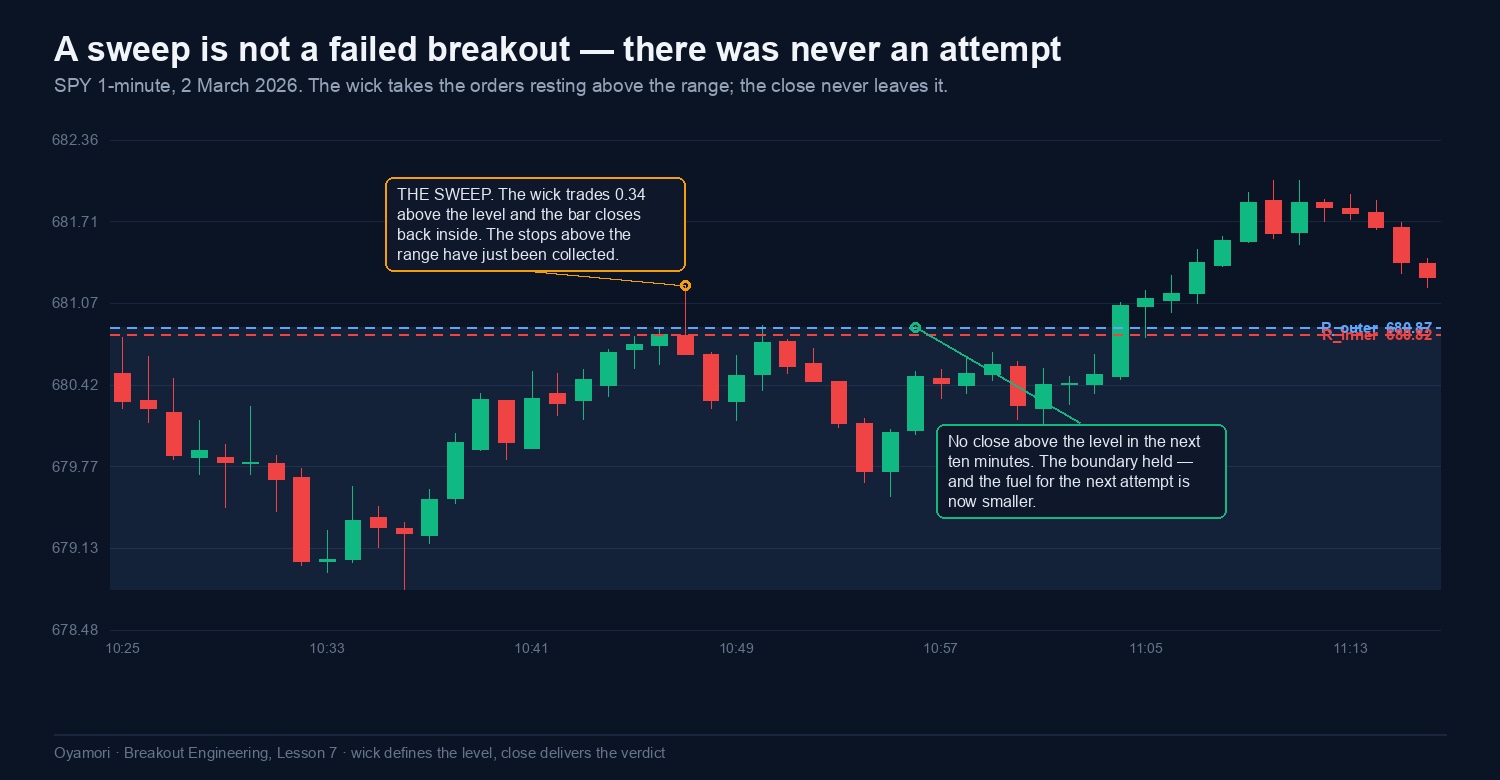
Most arguments about whether something was a breakout come from reading one candle as one event. It is two. The wick says how far price reached; the close says who won.
wick beyond R_outer, close back inside R_inner   →  SWEEP
close beyond R_outer                             →  ATTEMPT
two consecutive closes back inside R_inner       →  FAILURE
The four-level boundary model is what makes these separable. Collapse the range to one line and a sweep and an attempt look identical.
| Verdict | What happened | What it licenses |
|---|---|---|
| Sweep | Price reached beyond the extreme, stops fired, price returned inside the same bar or the next | Nothing on the long side. The level held and someone else was paid for it |
| Attempt | A close cleared the outer level. The thesis is live and unconfirmed | Entry by your plan, first harvest into the impulse, nothing more |
| Failure | Two consecutive closes back inside the inner level | Exit. The thesis is dead by its own definition |
The wick defines the level. The close delivers the verdict. Write that down before you argue with a chart again.
What a sweep is for
Picture selling 800,000 shares of SPY without walking the price down. Inside the range there is no demand worth the name — push size into balance and you pay for every tick. The one place a large volume of price-insensitive buying reliably exists is above the range high, where every short in the range has parked a stop.
So you buy a little, lift price through the level, the stops convert to market buys, and you sell your position into demand your own push created. That is not manipulation and it is not personal. It is the rational way to execute size in a market where the only concentrated liquidity sits at known locations.
Which gives sweeps directional content. A sweep of the upside that fails immediately has spent the buy-side fuel and handed inventory to a seller. A range that sweeps its low, reclaims, and then breaks its high is a better long than one that breaks its high cold — the sell-side stops are already cleared and pushing down has been shown not to work. A sweep above your range before your upside break is a negative for the same reason. This is order-flow reasoning, not something we have measured.
So should I wait for a sweep before entering?
No, and this is where the idea gets misused. You cannot know in advance whether a push above your boundary is a sweep or an attempt — that is what the close is for, and by the time the close resolves it, the sweep either happened or it did not. Sweeps occur on a minority of boundary excursions. Build an entry rule that requires one and you will skip the majority of attempts while waiting for a pattern that mostly does not arrive. Use the sweep as context when it appears in the history of the range; do not make your trigger conditional on it.
The related error is moving your stop somewhere "less obvious" to avoid the cluster. That makes it worse: the stop now sits at a price chosen for camouflage rather than at the price where your thesis is wrong.
Absorption or exhaustion
A break that stalls is not one thing. Two different sellers-of-the-story produce the same flat price with opposite meanings, and volume is what separates them.
| Absorption | Exhaustion | |
|---|---|---|
| Volume | elevated, often 1.5×+ average | falling, three bars or more |
| Bar range | compressed | compressed |
| Close position | mid-bar, nobody won | mid-bar, nobody won |
| Meaning | a large seller is meeting your demand | the buying stopped, no seller required |
Absorption calls for an immediate exit — somebody is actively distributing into your position and the reversal has a driver. Exhaustion is a dead trade rather than a dangerous one; the move sags back on thinning volume and you can leave without hurrying.
Stalling on falling volume is a pullback. Stalling on rising volume is a seller. With a volume histogram under the chart the read takes two seconds: tall volume bar, short price bar, above the boundary.
The trap is set during the impulse
Traps happen on setups that look good, because a setup that fails your filters never gets traded. Your worst losses will come from your better-looking charts. The sequence runs the same way nearly every time.
- The break triggers a full position.
- The impulse runs and the position goes green. Nothing is sold, because selling now would mean not letting it run.
- Price stalls above the boundary for two or three bars. Read as consolidation, which is sometimes correct.
- The first pullback dips into the boundary zone. Held, because retests are normal — correct general advice applied to a case where it does not hold.
- Price closes below the inner level. The thesis is dead, but the position is red and the trader waits for a bounce to exit at a better price.
- Capitulation, at or near the low, which is also where the reverse move is most attractive to enter.
The decision that determined the outcome is step 2, not step 5. A trader who sold a third of the position into the impulse arrives at step 5 with realised profit and a small position, and the exit costs nothing emotionally. Rules that fire before the pain starts beat rules that fire during it.
Why the reversal outruns the break
Failed breaks often reverse harder than the break itself, and the arithmetic is straightforward. Two flows point the same way at the same moment.
Trapped longs exit — their stops are sell orders, price-insensitive, hitting a book that is now thin below the boundary because all the quoting had moved above it. At the same time, new shorts enter on the recognised failure, and frequently the original seller is still working.
original break:  fuel = pre-existing short stops
failed break:    fuel = those stops (already spent)
                      + newly trapped long stops (created by the break itself)
                      + fresh short entries
That third line is the point. The failure manufactures its own fuel. Reversals are most violent when the break was large and well-participated (more trapped inventory), when absorption rather than exhaustion caused it, when the reclaim took one to three bars rather than six, and when the opposite boundary sits close enough to be a reachable target.
What a failure is worth
Failures are not flat. They move first, in the right direction, before turning — the finding at the centre of our study of these 489 breakouts.
Half of all failures gave a quarter of the range width inside ten minutes. Only a fifth gave half of it. So the failing breakout does pay something on the way out — enough to cover a first harvest, not enough to cover a target set where a working breakout would go. Costs are not included in any of these figures; on a 0DTE option the round-trip spread eats a meaningful share of 0.24W.
Trading the failure, with conditions
A confirmed failure is a setup in the opposite direction under specific conditions, and only then. The entry is not the moment of rejection — that is chasing an extended move. It is the retest of the boundary from below: price reclaims the inner level, bounces back up to it, and fails there. The old resistance has now proven it works from underneath, and the stop above the outer level is tight and structural. Targets are the range's own opposite levels, because the reversal's fuel is finite and discharges quickly.
Required, all of them: a confirmed rejection by the two-close rule, absorption rather than exhaustion during the failure, an opposite boundary far enough away to be worth the stop, higher-timeframe context that does not oppose the reverse direction, and half the size of a primary setup. Runners are a mistake here; the move terminates at the far boundary where a new structure begins.
Most traders should skip the reverse until the primary setup is consistently profitable. It demands reading absorption in real time and executing a tighter stop under emotional pressure, which is when execution is worst.
What you should take from this lesson
- Wick for the level, close for the verdict. A wick through the boundary that closes back inside is a sweep; a close beyond the outer level is an attempt; two consecutive closes back inside is a failure.
- A sweep is an execution technique, not a conspiracy. Large orders need concentrated liquidity, liquidity concentrates where stops cluster, and stops cluster where you would put one.
- Volume separates the two ways a break dies. Rising volume with no progress is a seller and calls for an immediate exit; falling volume with no progress is exhaustion and calls for a calm one.
- The trap tightens during the impulse, not during the loss. Every bad decision after the reclaim is downstream of holding a full position through the only window the market was reliably paying.
- Failures still move — 0.19W at five minutes, 0.24W at ten, with 49% reaching 0.25W and 21% reaching 0.50W across the 489 attempts. Enough for a first harvest, never enough for a breakout-sized target.
Next: the retest — what it actually tests, why the textbook version is wrong about it, and how to tell a retest that confirms from one that is the beginning of a failure.