The most expensive breakout is not the one that goes the wrong way. A break that fails immediately costs you the distance from entry to invalidation, which is small and known before you click. A break that goes your way, travels eleven cents, hits a wall you did not check for and then stalls costs you the same stop plus twenty minutes of decay plus the setup you did not take because you were busy managing this one. The direction was right. The trade was bad. And that outcome was decided before entry, by arithmetic you could have done in two minutes.
Six kinds of wall, and why you take the nearest one
Before any entry you need to know what sits between your trigger and your target — with prices, written down, not held in your head. There are six categories and every one of them is identifiable in advance.
1. Prior swing highs / lows        intraday structure, last ~2 hours
2. Session levels                  open, prior close, prior H/L, overnight H/L
3. Fair value gaps                 unfilled imbalances, opposing direction
4. Supply / demand zones           where price previously turned sharply
5. VWAP                            the reference a lot of execution is priced against
6. Round numbers and strikes       psychological orders plus dealer hedging
Two of these get read backwards often enough to be worth naming. A fair value gap in your direction is a low-resistance zone and a plausible target — price moves through unfilled gaps quickly because little is resting inside them. An opposing gap in your path is the reverse: a region where the other side was aggressive enough to create the imbalance, and price returning to it frequently gets turned. Most traders learn gaps as targets and never think of them as walls.
Supply and demand zones need discipline rather than technique. Two or three per session. Elaborate zone-drawing rules produce a chart where every price is inside a box, at which point the concept has no content.
The rule that does the work: take the nearest obstacle, not the one you judge most important. Traders inventory their levels and then reason about which ones "matter," and that reasoning is where the error enters. Price does not route around a level because you classified it as minor.
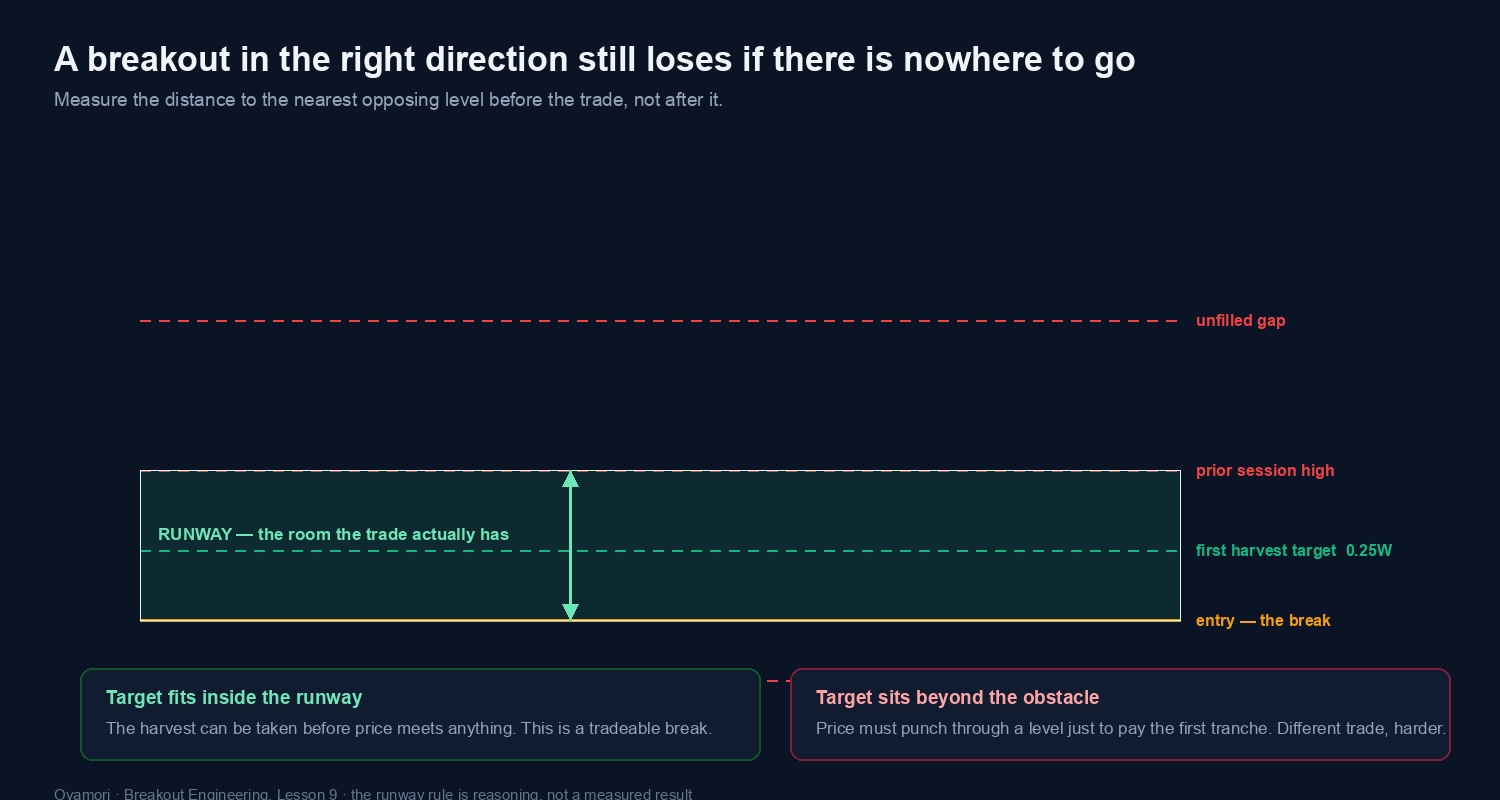
Runway is a distance, and it means nothing until you divide it by risk
Most people who do the inventory still stop one step short. They conclude "traffic is clear" or "traffic is bad" as a yes or no. It is neither. It is a distance, and a distance only acquires meaning next to your stop.
nearest_obstacle = the closest level ahead of entry, any category
runway           = |nearest_obstacle − entry|
risk             = |entry − stop|
runway_ratio     = runway / risk
Twenty cents of runway is generous against a six-cent stop and useless against a twenty-five-cent one. The ratio is the number that travels between setups; the raw distance does not.
< 1.5   no trade, whatever the setup score says
1.5–2.5 tradable, smaller, harvest into the obstacle
2.5–4.0 normal
> 4.0   full size, a runner is defensible
The sub-1.5 line is the one worth being rigid about. A setup with textbook compression, clean boundary tests and a runway ratio of 1.2 is not a trade, because those two things answer different questions. Compression quality is evidence about whether the move happens. Runway is the constraint on whether the move can pay you. A perfect answer to the first question does nothing about the second.
What we have measured, and what we have not
Say this plainly, because the site's credibility depends on it: we have not tested the runway rule on a large sample. The 1.5 threshold, the size tiers, the whole ratio framing — that is order-flow reasoning and arithmetic, not one of our measured results. Treat it as a way of organising a decision you were going to make anyway, not as an edge with a number attached.
What we have measured is the base rate the runway rule has to live inside. Across 489 breakout attempts on 490 SPY sessions, 75% ended back inside the range on two consecutive closes. Among the breakouts that held — the good outcome, the quarter of the sample you are hoping for — here is how far price actually travelled within ten minutes, in units of W, the width of the range that broke:
Read the third row against your target. Even when the break holds, fewer than a third of them cover a full range width inside ten minutes. If your first target sits beyond a wall, you are asking for an outcome that is uncommon among the winners, on a setup that fails three times in four. The full study of those 489 attempts has the rest of the distribution.
VWAP is context, magnet, or wall depending on which side you stand
VWAP earns its own note because it plays three roles and traders blend them. The role that belongs in this lesson is the third one.
| Position relative to VWAP | For an upside breakout |
|---|---|
| Price above VWAP, VWAP well below | Supportive context, no obstacle |
| Price above VWAP, VWAP a shade below | Supportive context, VWAP is your support |
| Price below VWAP, VWAP far above | Weak context, obstacle distant |
| Price below VWAP, VWAP a shade above | Weak context, obstacle immediate — skip |
Same indicator, opposite implications, decided entirely by which side of it you are on. Worth being mechanical about, because it is easy to get backwards in the moment.
Is a nearby obstacle always a reason to skip?
No, and the distinction is between levels that attract price and levels that only block it. Session extremes, round numbers and prior-day high/low pull price toward them — the resting liquidity is the reason price goes there — and then stall it. An opposing fair value gap, a supply zone, or VWAP approached from the wrong side mostly only block. When the nearest obstacle is a magnet, a marginal ratio can still support a small position that targets the obstacle itself and exits there in full, with no runner. When it only blocks, marginal means skip. This is the same four-kinds-of-boundary reading applied to the level in front of you rather than the one you are breaking.
Context: how much to bet, never when
Higher-timeframe work is where intraday traders lose their afternoons, because the search for alignment is unbounded — there is always another chart. Cap it at three, each answering exactly one question.
15m  →  bias        which way am I leaning
5m   →  structure   where the walls are
1m   →  execution   compression, boundary, trigger, management
The fifteen-minute chart does not get to comment on entries and the one-minute chart does not get to comment on bias. Most of the obstacles from part A live on the five-minute chart, which is what that layer is for.
Trend-aligned breaks have a mechanical argument behind them: the level you are breaking is more likely to be one that traders on slower charts also watch, so additional participation arrives over the following minutes, and pullbacks get bought by people whose plan has nothing to do with your range. Counter-aligned breaks face the opposite — everything the prevailing move ran through is now overhead, which is a runway problem as much as a bias problem. We have not measured the size of that difference, so treat it as one input among several rather than a filter.
Then the rule that keeps the whole layer honest: context adjusts your confidence and your size. It never becomes your trigger and it never vetoes.
The one apparent exception is VWAP sitting immediately overhead, and it is not a context veto at all. That is a traffic veto — the obstacle is close, which is arithmetic, not an opinion about direction.
What you should take from this lesson
- Take the nearest obstacle, not the most important one. Six categories, all knowable before entry, and price does not route around a level because you decided it was minor.
- Runway only means something divided by risk. The ratio travels between setups; the raw distance does not. Below roughly 1.5, the setup quality is irrelevant.
- Compression and runway answer different questions. One is evidence that the move happens; the other is the constraint on whether it can pay you. A perfect answer to the first does nothing for the second.
- The runway rule is reasoning, not a measured result. What is measured is the base rate around it: 75% of 489 attempts failed, and even among those that held, only 29% covered a full range width within ten minutes.
- Context sets size, never timing. Three timeframes, one question each, read once when the setup arms and written down — because re-reading a half-formed higher-timeframe bar under pressure is noise, not new information.
Next: the three entry models — immediate, retest and confirmation — the conditions that select between them, and where the stop belongs in each.