The impulse is over. Price sits a little above a level it spent twenty minutes underneath, you hold a reduced position with one harvest banked, and the market now begins answering a question that had no answer when you entered. You do not need that answer in advance. You do need to recognise it when it arrives, because it decides what happens to everything you are still holding.
The question the market is asking
Phrase it the way an auction theorist would: is the price above the old range a price at which two-sided business can be conducted?
Not "will it go up." Not "are buyers strong." Whether trade happens up there, or trade is refused.
A market that accepts a price trades there, repeatedly, with both sides participating. Volume builds and a new balance forms. That is acceptance, and it says nothing about price continuing — a market can accept a new level and sit on it for an hour.
A market that rejects a price refuses to do business there. Price visits, finds only one side willing, and leaves. Volume at the new level stays thin and one-directional, and price returns to where business was already being done.
- Acceptance — time and volume at the new price, two-sided.
- Rejection — a brief visit, thin volume, one-sided, then a return to old value.
Two observables, and neither is price: time and volume, measured at the new area rather than at the extreme. Price is the least informative variable at this moment — after an impulse it ticks up, ticks down, makes a new high by a penny and gives it back. Six bars have printed above the boundary is a fact, and it stays a fact whichever way the last tick went.
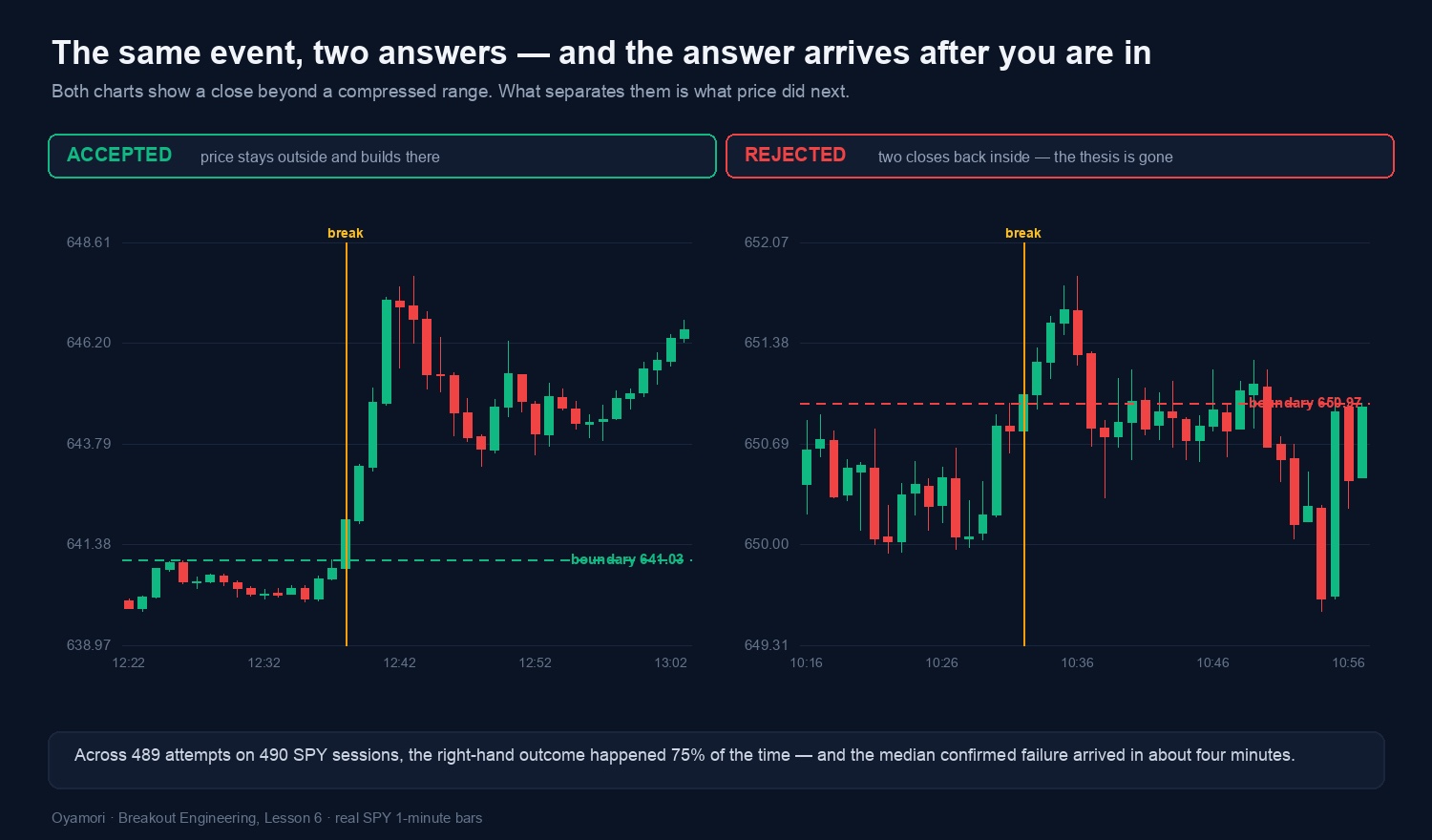
Rejection announces itself; acceptance takes its time
Failure is loud, fast and unambiguous. Success is quiet, slow and cumulative.
Across 490 SPY sessions and 489 first breakout attempts out of compressed ranges, the median time to a confirmed failure was 4 minutes (p25 2, p75 9). Half of all failures declared themselves inside four minutes. Acceptance is not established until a pullback has held and a higher low has formed above the boundary, which takes several times longer.
So: you will know you are wrong long before you know you are right.
Your posture after the impulse follows from that. Not "hold and see" — that treats both outcomes as equally likely to reveal themselves, and they are not. Hold a reduced position, lean toward the exit, re-engage only as acceptance evidence accumulates. The exit signal arrives first, and a false exit costs a fraction of what a slow exit costs on a decaying contract.
What "failed" even means
The failure rate of those 489 attempts depends on what you mean by failure, and the spread is wide enough to be a lesson in itself.
One sample, one instrument, three numbers. The strict definition — any close back inside — calls 83% of attempts failures. Requiring two consecutive closes drops that to 75%. And 47% never went anywhere at all: still inside the range half an hour later, an attempt that never got going rather than a violent rejection.
The eight-point gap between the two close-based definitions is roughly the population that dipped back in for one bar and then carried on. Whether those count as failures is a definition, not an observation — and it becomes load-bearing the moment you write it into a rule, because it decides whether you are out or still in. Choose one, write it down, stop renegotiating it mid-trade.
We use two consecutive closes back inside, on the reasoning that one close is inside the noise and two is a decision. That is a tolerance setting, not a measured edge, and the slower setting costs you more when the break has genuinely failed.
What the two outcomes are worth
The two populations differ in magnitude, and the gap opens early.
| Breakouts that held | Breakouts that failed | |
|---|---|---|
| Median result at +30 min | +0.81W | −0.34W |
| Median best price by +10 min | 0.72W | 0.24W |
| Reached 0.50W within 10 min | 75% | 21% |
W is the width of the range that broke — median 1.00 point on SPY, about 0.15% of price. Costs are not included in any of these figures.
Read the middle rows. By ten minutes the held group had been given three times the best price the failed group ever saw, and three-quarters of them had covered half the range width against a fifth of failures. That separation does not require thirty minutes to observe. It is visible in the first ten, which is why counting bars and volume beats staring at the tape.
The evidence, in the order it arrives
Acceptance is not a switch. It accumulates, and each increment has a matching position size. Four conditions, in rough order of arrival and increasing strength:
- Price is still above the outer boundary N bars after the break. Weak, and the earliest to arrive.
- A pullback occurs and holds above the inner boundary. Stronger — the market came back, tested, and buyers defended.
- Volume transacts at the new level, at or above the range average. Thin holding is weak holding.
- A higher low forms above the boundary, then a higher high. Strongest, and the slowest to arrive.
The fourth is worth double the others, because it is the only one requiring the market to have actively defended the new level rather than merely not having left it yet. Everything before it establishes that the break has not failed — a far weaker claim than establishing that it will continue.
Those weightings and thresholds are order-flow reasoning, not something we have measured. What we have measured is the timing asymmetry that makes scoring necessary instead of waiting for a binary.
Walk the states yourself, and note that each one checks its exit condition before its advance condition:
That ordering is deliberate. In any process managing money, the path that gets you out must be evaluated before the path that keeps you in, so ambiguous bars resolve toward safety.
Acceptance is not continuation
Traders conflate these and then feel betrayed.
Acceptance means the market has agreed to do business at the new price. Continuation means price keeps moving. The first does not imply the second. A large share of breaks that hold produce acceptance and then nothing: a new balance forms a few cents higher and sits there. By auction logic that is a successful breakout — value migrated, the level held. It also pays a scalper almost nothing past the first harvest, because there is no second leg to run into.
This is the mechanical reason old resistance becomes support on a retest. Not market memory, not psychology. The old boundary becomes the lower edge of the newly discovered value area, and the lower edge of a value area is where responsive buyers quote. Our study of 489 breakout attempts measures how rarely that discovery travels far enough to matter; the four-level boundary model tells you which edge to measure it against.
What if it never resolves either way — no failure, no new high?
That is the 47% still inside the range at thirty minutes, plus the ones drifting quietly a few cents outside it. Structurally it is a new balance forming immediately above the old one: value migrated a little, then stopped. Nothing has failed and nothing further is going to happen. On a decaying option this is the worst of the three outcomes, because time is a cost you pay whether or not price moves — a position that is not moving is losing. A hard time stop on the runner is the honest response. Not because anything changes at twelve or fifteen minutes, but because a break with no second leg by then has stopped being a breakout and become a position held out of hope.
What you should take from this lesson
- The market answers with time and volume at the new level, not with price. Count bars, count volume, stop reacting to the last tick.
- Rejection resolves faster than acceptance — median 4 minutes to a confirmed failure across 489 attempts. You will know you are wrong before you know you are right, so lean toward the exit by default.
- "Failed" is a definition, not an observation. 75% under two consecutive closes back inside, 83% under any close, 47% still inside at thirty minutes. Choose one before you enter.
- The outcomes separate early. Held breaks reached 0.72W by ten minutes against 0.24W for failures, and finished +0.81W against −0.34W at thirty.
- Acceptance is not continuation. Holding a runner needs a completed higher low then higher high above the boundary, not merely the absence of failure.
Next: the failures themselves — sweeps, traps, and the anatomy of how breakout traders become the liquidity for somebody else's entry.